The National Civil Rights Museum is a history museum in Downtown Memphis built around the former Lorraine Motel, where Dr. Martin Luther King Jr. was assassinated on April 4, 1968. The museum’s exhibits trace the American civil rights movement from slavery through the present, and the motel building itself — including the preserved room and balcony — is part of what visitors walk through.
What is the National Civil Rights Museum?
It is a museum at 450 Mulberry Street that documents the history of the civil rights movement in the United States, using the Lorraine Motel as its physical and narrative core. According to the museum’s own site, its exhibits run chronologically from the era of slavery and Reconstruction through the major campaigns of the 1950s and 1960s and into contemporary movements for racial justice. The museum opened in 1991 and underwent a major renovation and expansion completed in 2014, which added a second building across the street.
What is the Lorraine Motel?
The Lorraine Motel is the building the museum is built into and around. It began as the Windsor Hotel in 1925, was renamed the Lorraine Hotel in 1945, and operated for decades as one of Memphis’s motels serving Black travelers during the era of legal segregation. The museum’s own historical materials note that it was listed in the Green Book, the travel guide that identified lodging and businesses that served Black patrons safely under Jim Crow.
What happened at the Lorraine Motel?
Dr. King was shot on the second-floor balcony outside Room 306 on the evening of April 4, 1968, while in Memphis to support striking Black sanitation workers. He died at St. Joseph’s Hospital shortly afterward. The National Park Service and the museum both record the assassination as the event that closed the classical phase of the civil rights movement and reshaped the city’s own history.
Room 306, and the adjoining Room 307 where members of King’s staff were staying, have been preserved with period furnishings. A wreath has marked the section of balcony railing nearest the room since the site became a memorial.
How did the motel become a museum?
The Lorraine closed as a functioning motel in the early 1980s and faced foreclosure. A nonprofit, formed specifically to save the building, acquired it and converted it into a museum, which opened to the public in 1991. The building is listed on the National Register of Historic Places, reflecting its recognition as a site of national historical significance rather than simply a preserved motel.
The 2014 expansion added the museum’s second building, across Mulberry Street, which occupies the former boarding house from which the fatal shot was fired. That building now houses additional galleries examining the assassination, the investigation, and the trial and later legal proceedings connected to James Earl Ray, who pleaded guilty to the killing.
.jpg)
What does the museum’s collection actually include?
The museum’s own site describes a sequence of galleries rather than a single exhibit hall. Visitors move through a chronological narrative that includes:
- Exhibits on the transatlantic slave trade, Reconstruction, and the rise of Jim Crow segregation.
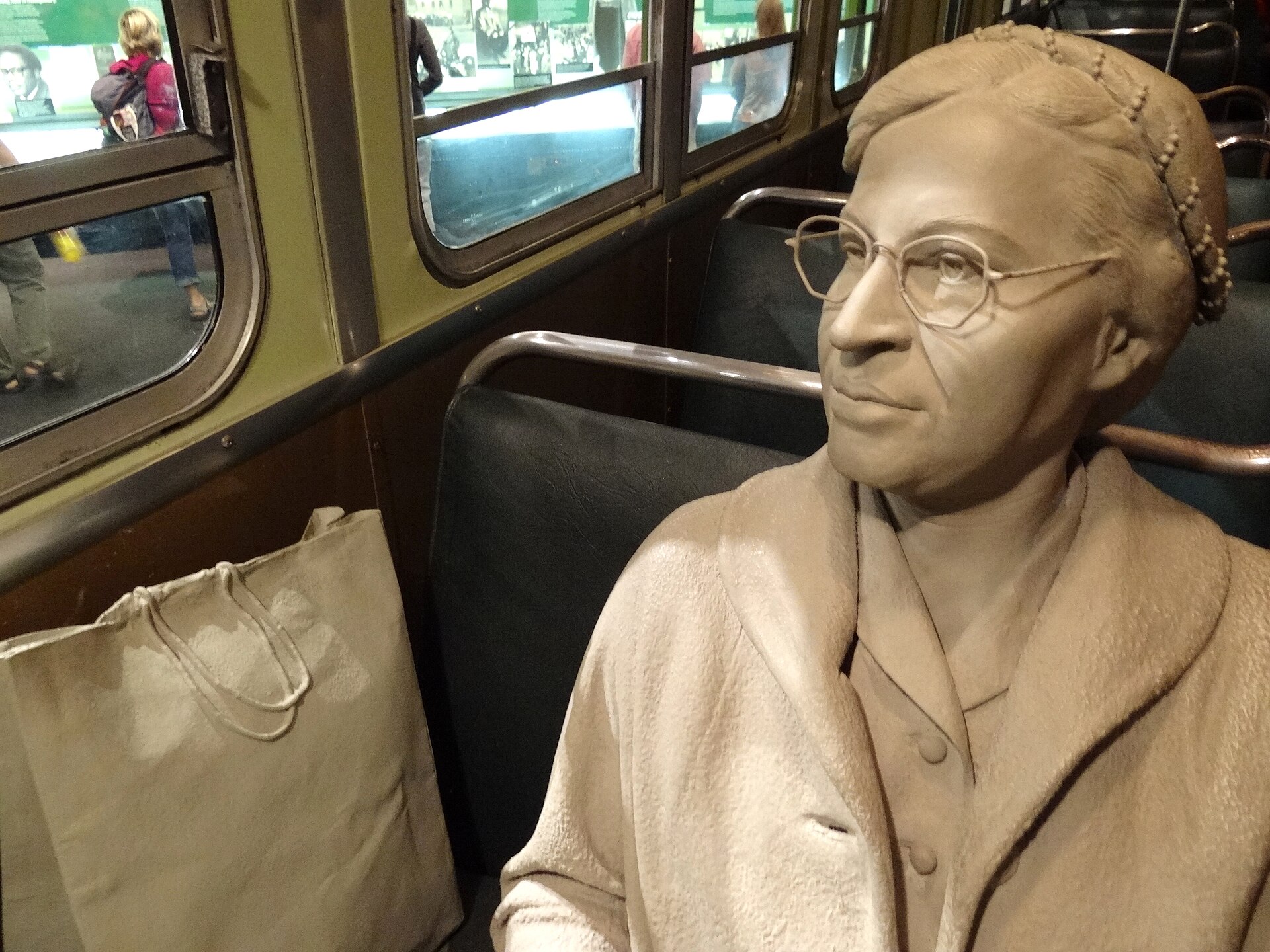
- A reconstructed segregated Montgomery city bus tied to the 1955–56 Montgomery Bus Boycott.
- Material on the 1957 desegregation of Little Rock Central High School and the 1961 Freedom Rides.
- A recreated lunch counter referencing the sit-in movement of the early 1960s.
- Coverage of the 1963 March on Washington and the 1965 Selma voting-rights campaign.
- A section on the 1968 Memphis sanitation workers’ strike, the context for King’s final trip to the city.
- The preserved motel rooms and the assassination galleries in the annex building.
Later sections of the museum extend past 1968 into subsequent civil rights and social justice movements, a structure the museum’s own site frames explicitly as ongoing rather than closed.
Is the museum only about the assassination?
No. The assassination is the reason the Lorraine Motel became a landmark, but the museum’s stated scope, per its own materials, is the broader movement — decades of organizing, legal challenges, boycotts and legislation — with the Memphis events treated as one chapter within that longer record rather than the museum’s sole subject.
How does this connect to other sites in Memphis?
Two other standing Memphis buildings are tied directly to the events surrounding King’s final visit. Clayborn Temple, an AME church downtown, is documented by the National Park Service and the Tennessee Historical Commission as the starting point for sanitation strike marches, including the march where the “I AM A MAN” placards were carried. Mason Temple, headquarters of the Church of God in Christ, is where King delivered his final public address, on the night of April 3, 1968, the evening before he was killed. Neither building is part of the National Civil Rights Museum’s physical campus, but both are referenced within its exhibits as part of the same sequence of events.
What should a visitor know before going?
The museum publishes its own hours, ticket prices, and any weekly closing day on its official site, and these details change, so the museum’s site is the source to check rather than any third-party listing. The museum has, in some years, tied special programming or free-admission windows to the Martin Luther King Jr. federal holiday in January and to the anniversary of the assassination in April; whether that applies in a given year should be confirmed directly with the museum.
The museum sits within Downtown Memphis, close to the South Main Historic Arts District, and is reachable on foot from much of the downtown core. Because the exhibits are dense and largely text- and artifact-based rather than passive viewing, the museum’s own guidance suggests allowing a substantial block of time to move through both buildings.
Why does this matter for understanding Memphis?
The National Civil Rights Museum is not a monument bolted onto the city after the fact — it occupies the actual building where the event happened, on the actual street, in a downtown that still contains Clayborn Temple, Mason Temple, and other sites named in the same historical record. Understanding the museum means understanding that Memphis’s civil rights history is not confined to a single exhibit hall; it is distributed across specific, standing, documented buildings that the museum’s own galleries repeatedly point back toward.
For current admission details, accessibility information, and hours, the National Civil Rights Museum’s own website is the primary source, and the National Park Service and Tennessee Historical Commission maintain the formal historic designations referenced throughout this article.
Access Memphis is an independent guide written from published, checkable sources. We have not visited the places described here and we do not publish personal recommendations or invented ‘local favourites’ — where something is singled out as notable, we say who says so. Opening times, fares, closures and prices change at short notice, so treat everything here as a starting point and confirm with the museum, operator or venue directly before building a day around it. We give no advice on visas, insurance, health or safety; use your own government’s official guidance for those.
Featured image: Photo by Adam Jones, Ph.D., source, CC BY-SA 3.0

Related reading
Living in Memphis, Memphis, Practically, What Is the Memphis Belle Exhibit, and Where Is It Now?, What Is Chucalissa, and What Is the C.H. Nash Museum?, What Is the Metal Museum, and Why Is It in Memphis?.