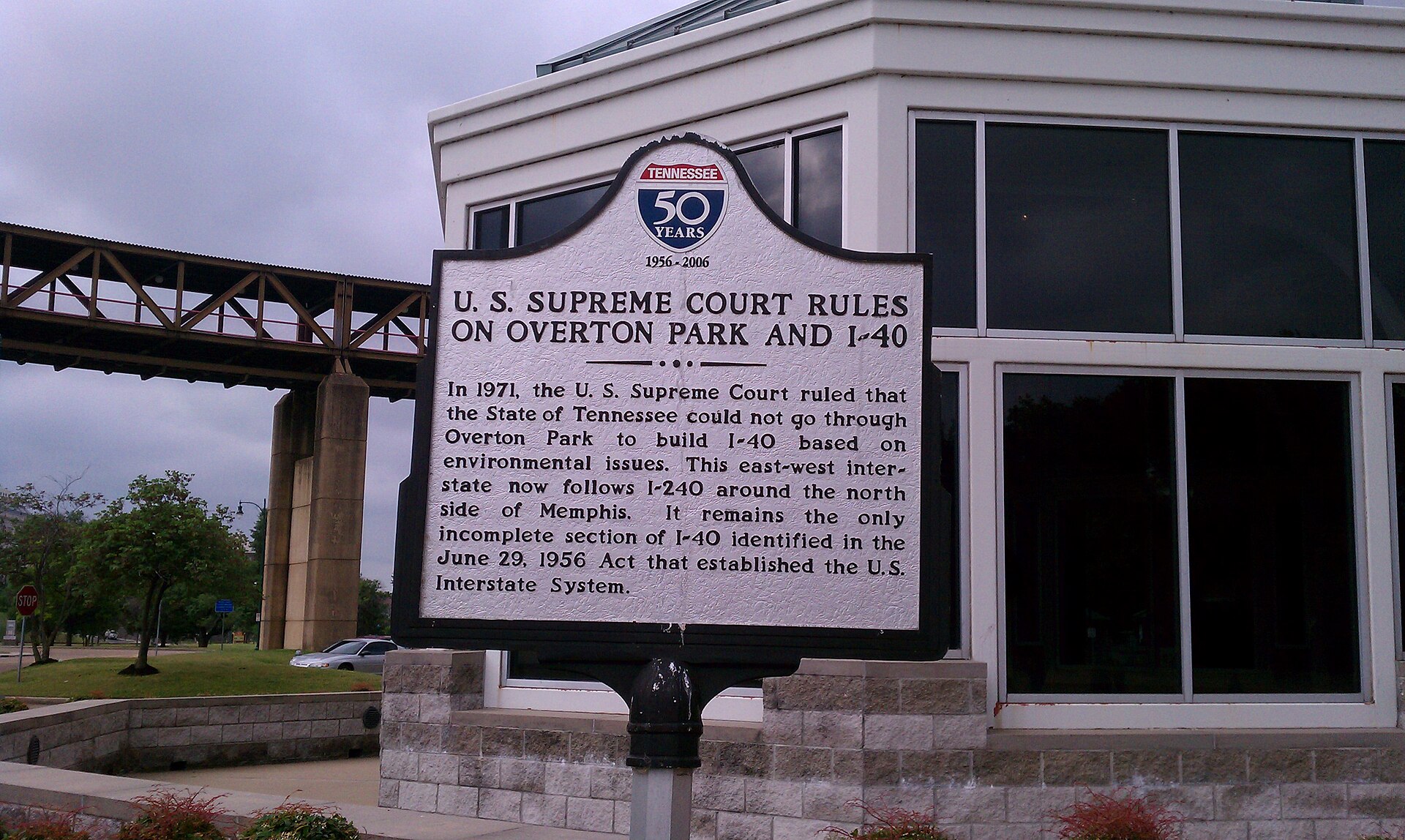
Overton Park stopped an interstate because a local citizens’ group sued the federal government, and in 1971 the U.S. Supreme Court ruled that the Secretary of Transportation had never properly justified routing Interstate 40 through it. The highway was never built there. I-40 was rerouted around Memphis instead, and the park stayed whole.
What was the interstate plan supposed to do?
In the 1950s and 1960s, federal and Tennessee highway planners mapped Interstate 40 to run straight through Memphis, connecting downtown to the eastern loop road that is now signed as Interstate 240. The planned route cut directly across Overton Park, a roughly 340-acre Midtown park laid out in 1901 by landscape architect George Kessler and home to the Memphis Zoo, the Levitt Shell amphitheater, and a tract of old-growth woodland known as the Old Forest, described in detail on Access Memphis’s guide to the park and its forest.
The proposed six-lane expressway would have sliced the park roughly in half, separating the zoo from the greensward and removing a strip of the Old Forest. Highway officials treated it as a routine link in the national interstate network — the kind of urban expressway being built through parks and neighborhoods in cities across the country at the time.
Who sued to stop it?
A group calling itself Citizens to Preserve Overton Park, Inc. formed to challenge the route. The organization argued that the federal government had ignored its own statutory limits on using public parkland for highways, and it took the case to federal court against U.S. Secretary of Transportation John Volpe.
The legal argument rested on two federal laws passed in 1966 and 1968:
- Section 4(f) of the Department of Transportation Act of 1966, which barred the Secretary from approving federally funded highways through public parkland unless there was no “feasible and prudent” alternative route.
- A companion provision in the Federal-Aid Highway Act of 1968 requiring the same standard, plus “all possible planning to minimize harm” if parkland use went ahead.
The citizens’ group argued the Secretary had never made the required findings — he had simply approved the route without explaining, on the record, why no other option existed.
What did the Supreme Court actually decide?
The case, Citizens to Preserve Overton Park, Inc. v. Volpe, reached the Supreme Court in 1971. Writing for the Court, Justice Thurgood Marshall held that the Secretary’s approval could not stand without a clear, reviewable record showing that alternatives had genuinely been considered and rejected for specific reasons. The opinion is preserved in full and publicly citable at Cornell Law School’s Legal Information Institute.
The Court did not rule that the highway could never be built. It ruled that the decision-making process behind it had failed to meet the statute’s requirements, and it sent the case back to the lower courts for a fuller review of the administrative record. That distinction mattered: the case became a landmark in administrative law far beyond Memphis, establishing that federal agencies must show they took a “hard look” at the facts and alternatives before approving projects with statutorily protected consequences — a standard still cited in environmental and land-use litigation today.
What happened between 1971 and the road’s final defeat?
The remand did not settle the matter quickly. Litigation and administrative review continued through the 1970s, with the citizens’ group and preservation allies continuing to press the case at every stage. Federal transportation officials never produced findings strong enough to satisfy the courts that no feasible alternative to the park route existed.
By the early 1980s, the Federal Highway Administration formally withdrew approval for the Overton Park segment of I-40, closing out more than fifteen years of litigation and effectively killing the project. The land that had already been cleared or acquired along the intended corridor was left in limbo for years before being repurposed for local use rather than an interstate.


Where did the interstate go instead?
Memphis never got a continuous I-40 running straight through the middle of the city. Instead, I-40 traffic is carried around Midtown on the northern and eastern legs of the loop road signed as I-240, joining back to a more direct alignment east of the city. Downtown, I-40 still crosses the Mississippi River on the Hernando de Soto Bridge, but the segment that would have run east through Overton Park simply does not exist as an interstate.
Part of the cleared right-of-way east of the park was eventually built out as Sam Cooper Boulevard, a surface arterial rather than a limited-access expressway — a much smaller road than what was originally planned, running through repurposed land instead of through the park itself. Readers who drive in Memphis today, or want to understand why the interstate grid around Midtown looks the way it does, can find more on how the city’s roads actually connect in Access Memphis’s guide to driving in Memphis.
What does Overton Park look like today because of this?
Overton Park remains intact as a single contiguous park rather than two halves divided by a sunken expressway. It continues to hold the Memphis Zoo, the Levitt Shell, walking paths through the Old Forest, and open greensward used for informal recreation. Overton Park is listed on the National Register of Historic Places, and its Old Forest section is separately recognized for its old-growth character, details covered on Access Memphis’s dedicated page about what the park and forest actually are.
The park sits at the edge of Overton Square, the entertainment and dining district explained in Access Memphis’s guide to Overton Square, and within the broader Midtown area covered in the site’s explainer on what Midtown Memphis actually is. The park’s survival is part of why that stretch of the city reads today as a walkable, tree-covered district rather than one bisected by a six-lane trench.
Why does this case matter beyond Memphis?
Legal scholars and administrative-law casebooks cite Overton Park v. Volpe as one of the defining Supreme Court rulings on how federal agencies must justify decisions that affect protected resources — not just highways through parks, but a wide range of agency actions subject to judicial review. The University of Memphis and other law programs continue to teach the case as a foundational example of the “hard look” doctrine in U.S. administrative law.
For Memphis specifically, the case is also a documented instance of a local citizens’ organization successfully overturning a federal infrastructure decision through litigation rather than protest alone — a fact that shapes how the city’s parks and preservation groups still describe their own leverage today. Readers interested in how the city’s green spaces function more broadly can browse Access Memphis’s Parks & Riverfront category, and those looking at how neighborhoods and districts across Memphis are organized can start from the Neighbourhoods archive or the Living in Memphis hub.
Related reading
getting around, planning, itineraries, food and the riverfront, The Memphis Guide, What Is the Memphis Zoo, and What Does It Hold?
Access Memphis is an independent guide written from published, checkable sources. We have not visited the places described here and we do not publish personal recommendations or invented ‘local favourites’ — where something is singled out as notable, we say who says so. Opening times, fares, closures and prices change at short notice, so treat everything here as a starting point and confirm with the museum, operator or venue directly before building a day around it. We give no advice on visas, insurance, health or safety; use your own government’s official guidance for those.
Featured image: Photo by Brian Rawson-Ketchum [2], source, CC BY-SA 2.0
