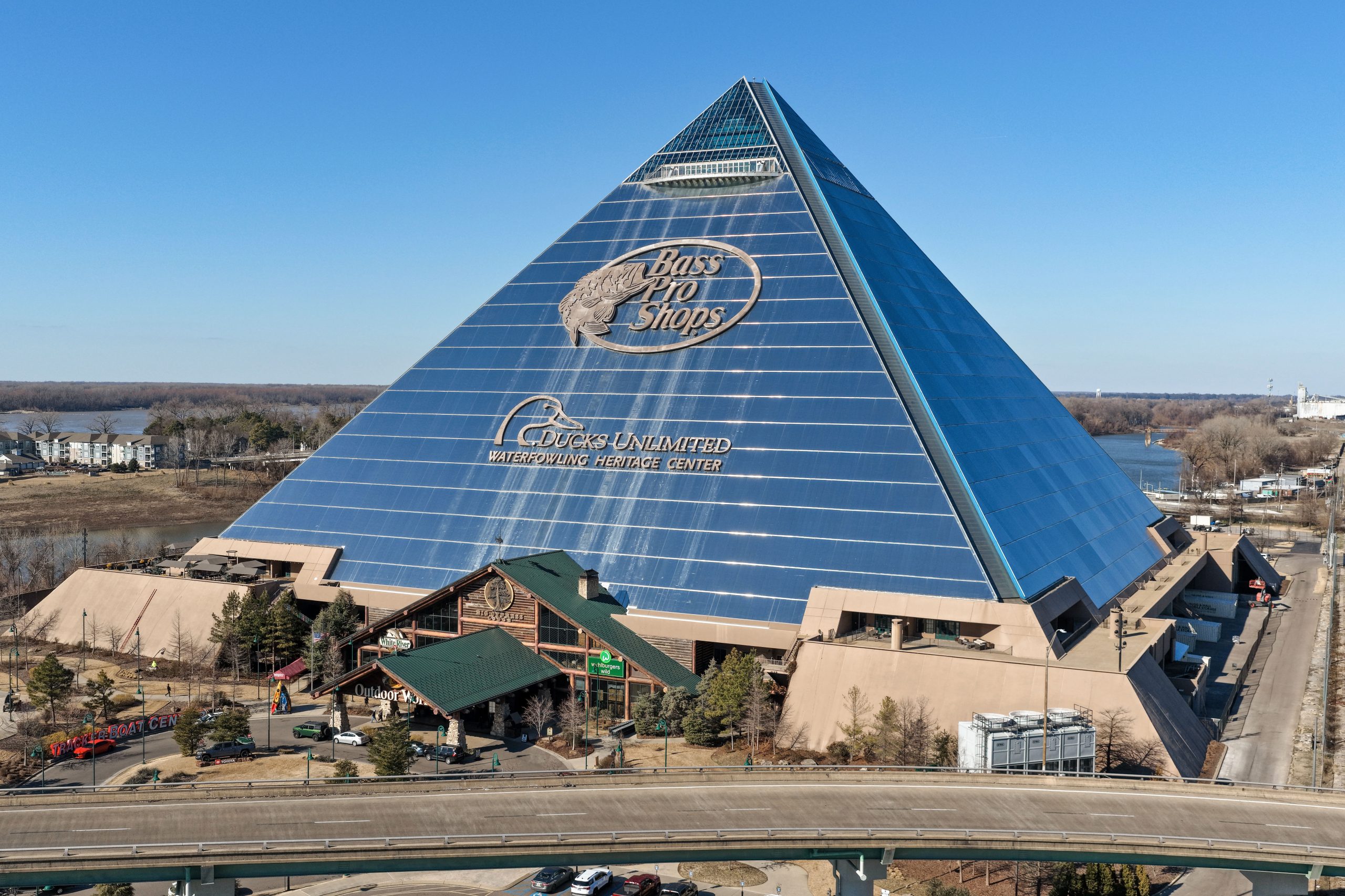
The Memphis Pyramid is a 321-foot stainless-steel pyramid on the Memphis riverfront, built in 1991 as a sports arena for the University of Memphis and, briefly, the Memphis Grizzlies. It sat empty for a decade after the teams moved out, and in 2015 the retailer Bass Pro Shops reopened it as a store, hotel and attraction complex, leasing the building from the city of Memphis rather than owning it.
What is the Memphis Pyramid, structurally?
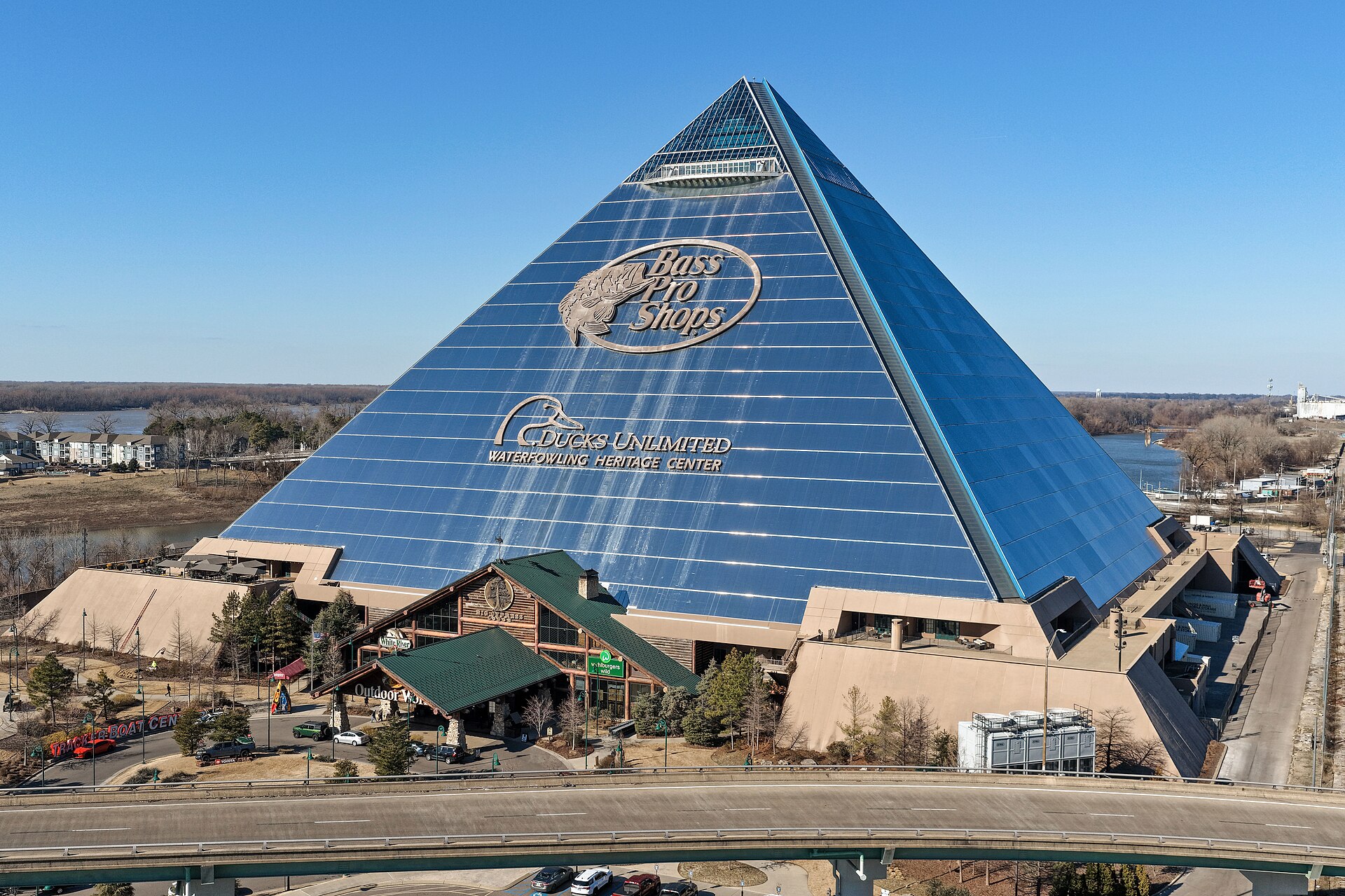
It is a steel-framed, stainless-steel-clad pyramid standing on the west edge of downtown Memphis, on the Wolf River Harbor across from Mud Island River Park. The building was originally called The Pyramid or the Great American Pyramid, and its shape was a direct reference to the city’s own name — Memphis, Tennessee, was named after the ancient Egyptian capital on the Nile, and Shelby County has leaned on that Egyptian association in civic branding for well over a century.
It opened in November 1991 as a 20,000-plus-seat arena, built and financed jointly by the city of Memphis and Shelby County. Bass Pro Shops’ own materials describe the structure as one of the largest pyramids in the world by volume, a claim tied to its base footprint rather than its height, since several other pyramids worldwide stand taller.
What was the Pyramid used for before Bass Pro Shops?
For thirteen years it was Memphis’s main arena. The University of Memphis Tigers played basketball there through the 1990s and into the 2000s, and the NBA’s Memphis Grizzlies, who relocated from Vancouver in 2001, used it as a home venue for their first three seasons in the city. Concerts, the circus and other large touring events also booked the space.
Neither tenant stayed. FedExForum opened in downtown Memphis in 2004, purpose-built with modern arena amenities and luxury suites that the Pyramid’s early-1990s design couldn’t match economically, and both the Tigers and the Grizzlies moved there. The Pyramid lost its reason for existing almost overnight.
Why did the Pyramid sit empty for so long?
After 2004 the building had no anchor tenant and no clear commercial use. It is a single, enormous, oddly shaped volume — hard to subdivide, expensive to climate-control, and landlocked by its own geometry in ways a rectangular warehouse or arena shell is not. The city of Memphis, which owned the building outright, spent roughly a decade fielding proposals — casinos, retail centers, entertainment complexes — most of which stalled over financing or feasibility. For much of that period the Pyramid stood dark on the riverfront, a landmark with nothing happening inside it.
Why is there a Bass Pro Shops inside it?
Bass Pro Shops, the Missouri-based outdoor-sporting-goods retailer, agreed to lease the building from the city of Memphis and fund its conversion into a flagship store, ending the redevelopment stalemate. The deal, finalized earlier in the 2010s, kept the city as owner of the structure while handing Bass Pro a long-term lease and design control over the interior. Construction ran for roughly two years before the store opened to the public in 2015.
The pitch, from the city’s side, was straightforward: a private company would take on the enormous renovation cost of an unused landmark in exchange for the exposure and floor space a building of that scale and visibility offers nowhere else in the Bass Pro chain. It is the company’s largest store, and the only one built inside a former sports arena shaped like an Egyptian pyramid.
_-_Memphis,_TN_(cropped).jpg)
What is actually inside Bass Pro Shops at the Pyramid?
The retail floor sells the standard Bass Pro range — hunting, fishing, camping and boating equipment, along with clothing and general outdoor gear — arranged around the building’s open central atrium rather than in conventional aisles. Beyond the sales floor, the redevelopment added several features specific to this location:
- Big Cypress Lodge, a roughly 100-room hotel built into the upper levels, decorated around a cypress-swamp theme.
- An indoor cypress swamp at ground level, with live alligators and turtles, standing in the space where the arena’s basketball court once was.
- The Lookout at the Pyramid, an observation deck near the top of the structure with a glass floor section looking straight down the building’s interior.
- A freestanding glass elevator that Bass Pro’s own site describes as one of the tallest of its kind in the country, used to reach the Lookout.
- A bowling alley, restaurants and a duck pond, all built within the existing pyramid shell rather than as separate additions.
None of this is described here as an experience worth having — that is a judgment for the operator’s own marketing, not for a reference article. What’s verifiable is the inventory of what the building now contains, which is unusually broad for a retail lease: shop floor, hotel, wildlife exhibit and observation deck, all inside a structure that spent its first thirteen years as a sports arena.
Is the Memphis Pyramid open to the public without paying for the Lookout or staying at the lodge?
The retail floor and swamp exhibit are open to anyone during store hours, as with any Bass Pro Shops location. The observation deck and glass elevator are a paid add-on, and the lodge rooms are booked as a hotel stay. Because retail hours, ticketed-attraction pricing and hotel rates all change, this article does not quote current figures — Bass Pro Shops’ own site for the Pyramid location is the source to check before planning a visit.
How does the Pyramid fit into the rest of downtown Memphis?
Geographically, it sits at the northern edge of downtown, near the Pinch District and within walking distance of the Mississippi riverfront trail and Mud Island River Park. It is not part of the Beale Street entertainment district or the cluster of civil rights and music sites further south and east in downtown, though all of them fall within the same broad downtown area covered on this site’s Memphis guide hub and landmarks and sights archive.
For residents, the Pyramid’s story is a useful case study in how the city has repeatedly repurposed large, purpose-built structures once their original use expired — a pattern also visible at the Pink Palace and in several of downtown’s converted warehouse buildings. Anyone interested in how Memphis’s institutions are funded, owned and operated — civic assets leased to private operators, museums run as nonprofits, or venues owned outright by the city — can find more of that context on the living in Memphis hub.
What else is nearby, and how should a visit be planned?
The Pyramid stands apart from most of downtown’s museum cluster, so a visit typically means treating it as a standalone stop rather than pairing it with a single afternoon of Beale Street or the Civil Rights Museum. Details on getting around downtown, including how the riverfront trolley and walking routes connect the Pyramid to the rest of downtown, are covered on the Memphis practical hub.
Readers building a downtown itinerary around music history rather than retail can find the relevant context on what is actually on Beale Street and at the Memphis Music Hall of Fame, both a short distance south of the Pyramid. For museums that charge no admission at all, including some days when major downtown institutions waive their fee, see which Memphis museums are free, and when.
The Pyramid itself charges for its paid attractions, and is not free, but it remains one of the few buildings in Memphis that a visitor can identify from across the river without needing a map — a landmark that changed use entirely rather than closing, which is a rarer outcome for a stranded 1990s arena than the building’s current gift-shop atmosphere might suggest.
Access Memphis is an independent guide written from published, checkable sources. We have not visited the places described here and we do not publish personal recommendations or invented ‘local favourites’ — where something is singled out as notable, we say who says so. Opening times, fares, closures and prices change at short notice, so treat everything here as a starting point and confirm with the museum, operator or venue directly before building a day around it. We give no advice on visas, insurance, health or safety; use your own government’s official guidance for those.
Featured image: Photo by Quintin Soloviev, source, BY