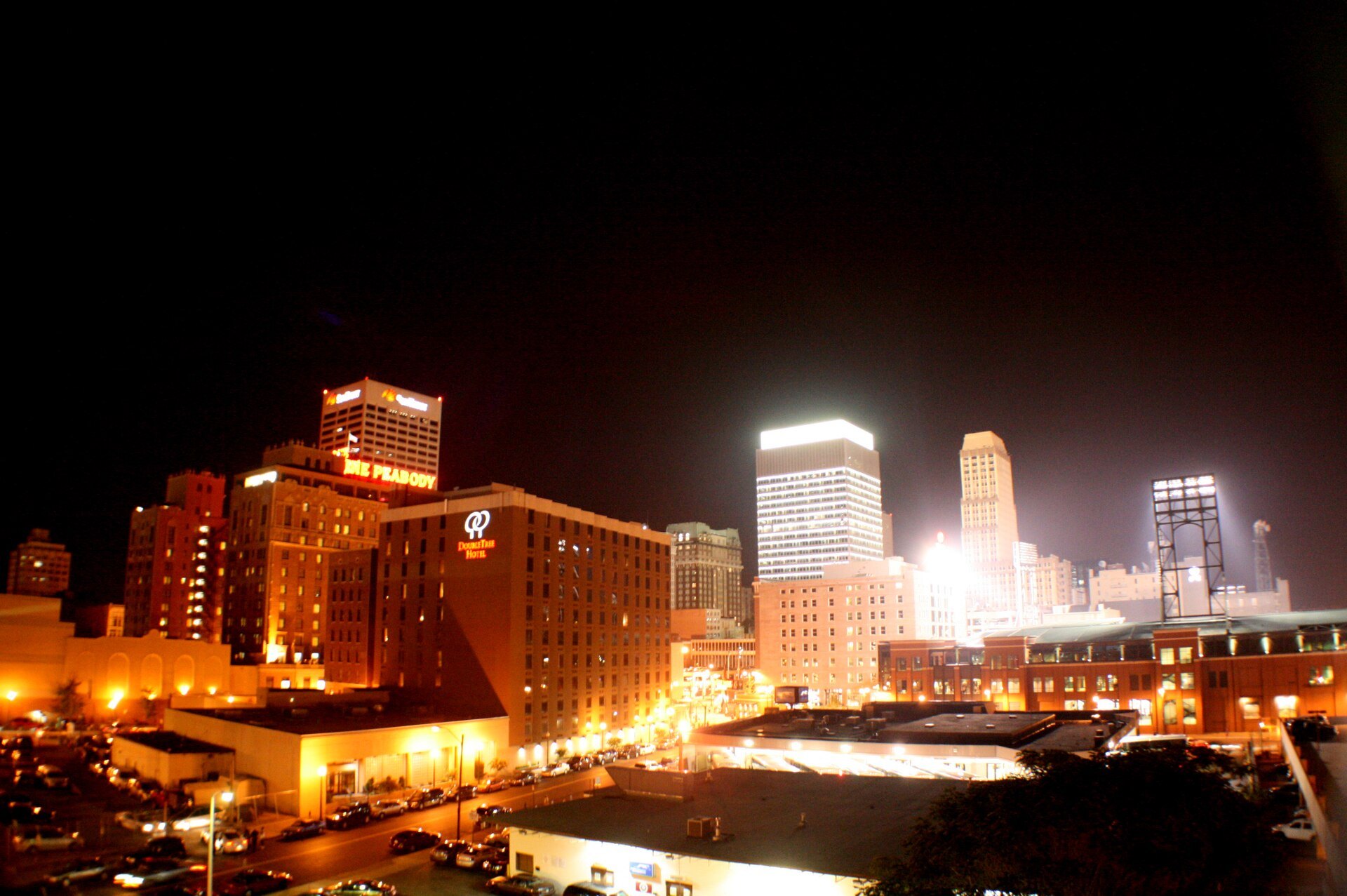
The Pinch District is a small area just north of downtown Memphis, between North Main Street and the Wolf River Harbor. It was the city’s immigrant and wholesale-market quarter from the 1840s into the mid-1900s. Most of that history is gone now. What stands there today is mostly vacant land, a handful of older buildings, and a slow-moving private development called Union Row.
Where is the Pinch District, and why is it called that?
The district runs along a strip of high ground between North Main Street and the river bluff, roughly from the area around the Pyramid north toward the Interstate 40 bridge approach. Local histories trace the name to “Pinch Gut,” a 19th-century nickname for poor Irish immigrants who settled there. People said their faces looked pinched with hunger.
Immigrant communities filled the area through the second half of the 1800s. Irish families came first, followed by Jewish, Italian, and Chinese households. Many worked the wholesale produce houses, dry-goods stores, and small shops that lined its streets. Market Square anchored much of that trade. Warehouses handled goods moving off the river and the rail lines nearby.
Interstate 40 now crosses the river a few blocks north of the district. That bridge was built after an earlier plan to route the interstate directly through Overton Park was defeated in court. The highway’s eventual path still cut off some of the Pinch’s edges from the rest of downtown.
What did the city plan for the Pinch District?
Memphis, working with the Downtown Memphis Commission, adopted a redevelopment framework for the Pinch District in the late 2010s. The goal was straightforward: turn vacant and underused parcels into mixed-use blocks — apartments, retail, and public open space — connected to the Uptown neighborhood to the west and the Medical District to the east.
The plan itself did not fund construction. It set zoning and design expectations for whoever eventually built there. That turned out to be a single large private developer, not a series of smaller infill projects.
What is Union Row, and what has it actually built?
Union Row is the private development the city’s plan was effectively built around. Its developers announced the project in 2022, describing a footprint of roughly 30 acres of parking lots and underused buildings between North Main Street and the river. Public announcements at the time put the planned investment above $1 billion, phased over a decade or more: residential towers, a hotel, office space, a grocery store, and street-level retail.
Those figures came from the developer. They were not independently audited, and they describe a plan rather than a finished project.
| Year | What happened | What it means now |
|---|---|---|
| Late 2010s | City and Downtown Memphis Commission adopt a redevelopment framework for the district | Sets zoning and design goals; no construction funded directly |
| 2022 | Union Row announced publicly, roughly 30 acres, investment described as $1 billion-plus | Figures are the developer’s own; not yet independently verified by a completed project |
| 2022–2023 | Site assembly begins; some older low-rise buildings cleared from parts of the footprint | Clearing is visible; no tower construction completed |
| 2023–2024 | Local business press describes slow pace; most parcels remain cleared lots or parking | No residential tower has topped out as of this reporting |
| Ongoing | Status changes without much public notice between filings | Check the developer’s own materials or city planning updates before relying on any figure here |
As of the most recent local business-press reporting, most of the Union Row footprint remained cleared lots, surface parking, or site-preparation work rather than finished buildings. A handful of structures had come down to make way for later phases. No tower had topped out. That gap between the renderings released in 2022 and what sits on the ground now is the single most useful thing to understand about the Pinch District today.
Anyone who wants the current state should check the Downtown Memphis Commission’s own project updates directly, since a photograph of a vacant lot taken one year can look very different the next.
Does the University of Memphis or UTHSC factor into this?
Some coverage of growth near the Pinch District points to health-sciences expansion. That growth is driven mainly by the University of Tennessee Health Science Center, not the University of Memphis — the two are separate institutions, and it is worth being precise about which one is which. UTHSC’s main campus sits along the district’s eastern edge, in the area the city designates as the Medical District, sometimes overlapping with what is marketed as the Edge District.
Long-range facilities planning for that campus runs through the Memphis Medical District Collaborative, a nonprofit partnership of the area’s hospitals and universities, with details published on UTHSC’s own site. Its plans touch the fringes of the Pinch footprint. They are a separate process from Union Row, run by a different set of institutions on a different timeline.
What already stands in and around the district?
The most visible fixed point near the Pinch District is the Pyramid. It was built as an arena in 1991, stands roughly 321 feet tall, and closed as a sports venue in 2004. It reopened in 2015 as a Bass Pro Shops retail and hotel complex, a conversion the company has documented on its own materials.
A few blocks south, the Renasant Convention Center — formerly the Cook Convention Center — reopened after a renovation completed around 2020, according to the facility’s own public materials. That gives the wider area a large, fixed anchor at its southern edge, independent of whatever happens with Union Row.
Immediately north and west, the Uptown neighborhood went through its own public-private redevelopment starting in the early 2000s, built mostly around new housing rather than commercial infill. It is a useful comparison: a slower, more incremental model than the single-developer approach the Pinch District is now waiting on.
What does this mean for someone visiting today?
A visitor walking the Pinch District today will find surface parking and construction fencing more than a finished neighborhood. The Pyramid, the riverfront, and downtown’s Main Street corridor remain the functioning destinations nearby. For a sense of how the riverfront itself has changed in recent years, the riverfront’s current shape
Related reading
what the city is like to actually live in, getting around, planning, itineraries, food and the riverfront, museums, landmarks, neighbourhoods and day trips, Beale Street Baptist Church and Its Civil-Rights History.
Access Memphis is an independent guide written from published, checkable sources. We have not visited the places described here and we do not publish personal recommendations or invented ‘local favourites’ — where something is singled out as notable, we say who says so. Opening times, fares, closures and prices change at short notice, so treat everything here as a starting point and confirm with the museum, operator or venue directly before building a day around it. We give no advice on visas, insurance, health or safety; use your own government’s official guidance for those.
Any prices mentioned are indicative only. Tool prices move constantly and vary by market, by retailer, and by whether a kit includes batteries or a charger — check the current price yourself before deciding.
Featured image: Photo by Lindsey Turner, source, CC BY 2.0
