
Graceland is the mansion Elvis Presley bought in 1957 in the Whitehaven area of Memphis, and it is now a house museum and entertainment complex open to the public. A visit covers the home itself, the graves of Presley and family members in the grounds, and a separate exhibition campus across the street covering his cars, planes and career.
Who owns and runs Graceland?
Graceland is operated by Elvis Presley Enterprises, the company that manages the Presley estate’s commercial interests, including the property and its exhibits. The mansion and roughly 13.8 acres of grounds are listed on the National Register of Historic Places and designated a National Historic Landmark, a status recorded by the National Park Service. That designation reflects the site’s significance to American cultural history — specifically Presley’s career and the development of the Memphis sound — rather than any judgment about architecture alone.
Because Elvis Presley Enterprises is the operator, all hours, ticket tiers and current exhibit details should be confirmed on Graceland’s own site rather than assumed from older listings. The property has expanded significantly since it opened to the public in 1982, and what a given ticket includes has changed over the decades.
What’s inside the mansion itself?
The house tour moves through a fixed circuit of rooms Presley actually lived in and decorated, not a recreation. Graceland’s own materials describe several rooms that draw the most attention:
- The Jungle Room, a den with green shag carpet and Polynesian-style furniture that also functioned as a home recording space in Presley’s later years.
- The living room and music room, kept largely as furnished during Presley’s occupancy.
- The Trophy Building, a long addition housing gold and platinum record awards, stage costumes and career memorabilia.
- The Hall of Records, dedicated to the timeline of Presley’s recording and film career.
The upstairs private quarters, including Presley’s bedroom, are not part of the tour and never have been; Graceland has kept that floor closed to visitors since the house opened to the public.
Where is Elvis actually buried?
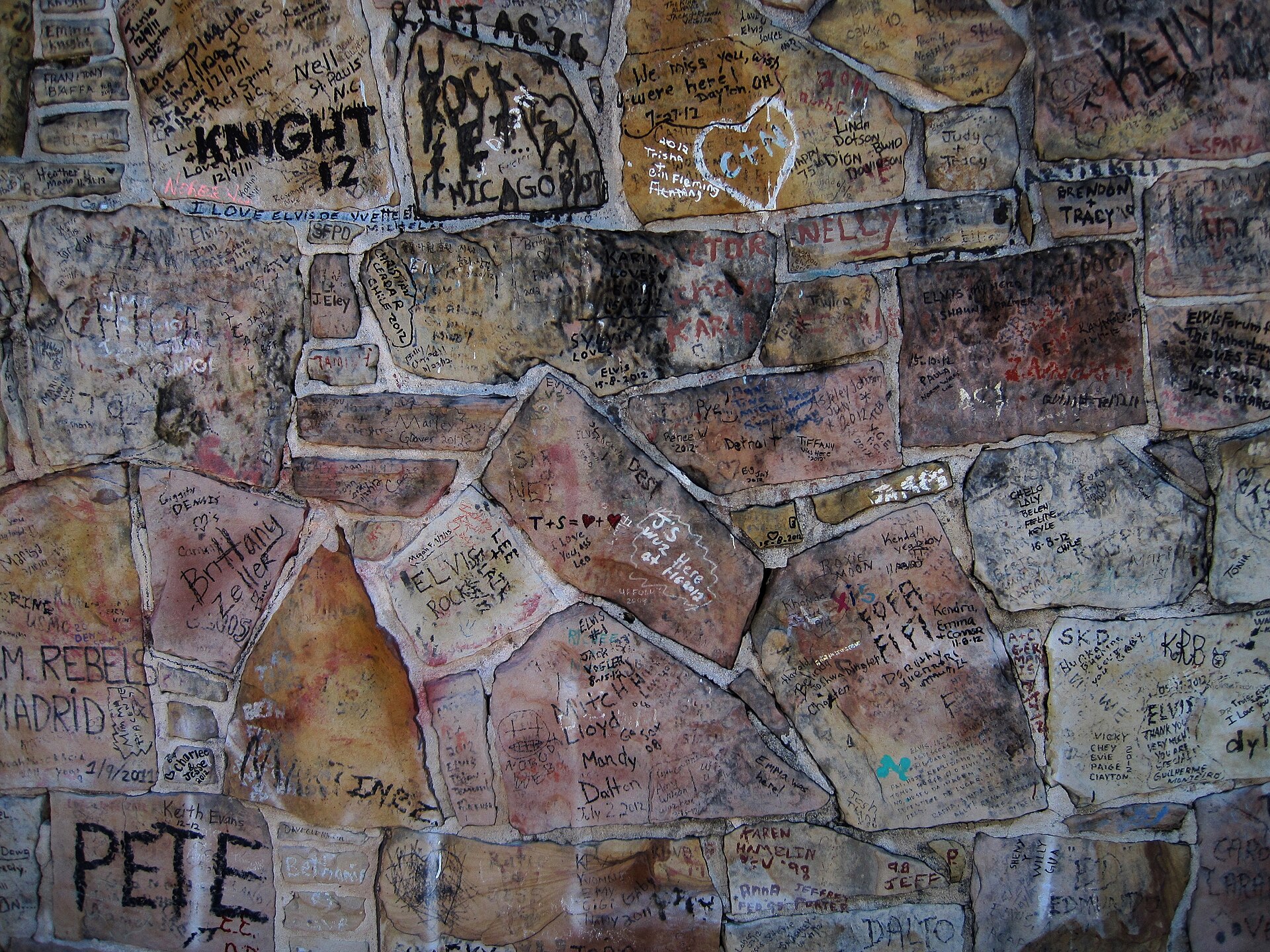
Presley is buried in the Meditation Garden, a landscaped plot beside the house, alongside his parents Vernon and Gladys Presley and his grandmother. He was originally interred at Forest Hill Cemetery in Memphis; the graves were moved to Graceland’s grounds in 1977 following a reported security concern, a move documented in Graceland’s own history of the property. The garden remains part of the standard house tour and is generally treated as the emotional center of a visit, a framing Graceland itself uses in its own materials.

What else is at Graceland besides the house?
Since the 1980s the complex has grown well beyond the mansion. Across Elvis Presley Boulevard from the house, Graceland operates an exhibition campus that includes:
- An automobile museum housing Presley’s car collection, including the well-known pink Cadillac.
- Two private aircraft, the Lisa Marie and the Hound Dog II, both retained from Presley’s ownership.
- A dedicated exhibition space, Elvis: The Entertainer Career Museum, covering his stage and film career with costumes and staging material.
- Rotating temporary exhibitions organized by Elvis Presley Enterprises, which change on a schedule set by the operator.
This campus, sometimes referred to by Graceland as the “Exhibition Center,” is a separate ticketed component from the mansion tour, and current bundling of tickets should be checked directly with the operator.
Is Graceland a museum or a historic site?
It functions as both, and the distinction matters for what a visitor should expect. As a National Historic Landmark, the mansion and its immediate grounds are preserved as a historic property — the National Park Service’s designation concerns the site’s authenticity and its connection to a documented figure in American music history. As a museum, the surrounding complex is a commercially curated career retrospective, built and expanded by Elvis Presley Enterprises specifically to be toured.
That combination — a preserved private home plus an added exhibition business around it — is not unusual among American house museums tied to a single public figure, but it is worth understanding before arriving: the mansion tour and the exhibition campus are different kinds of experience, one a fixed historic interior, the other a growing commercial collection.
How does a visit actually work?
Graceland sells tickets in tiers that generally combine the mansion tour with varying amounts of access to the automobile museum, aircraft and career exhibits; the exact tiers and what each includes are set by Elvis Presley Enterprises and change periodically. The operator’s own site is the only reliable source for current pricing, hours and any seasonal closures, and this article does not attempt to state figures that go stale within months.
The mansion tour itself is typically self-guided using an audio device, a format Graceland has used for years, though the technology behind it has been updated more than once. Because the property draws heavy visitor volume around Presley’s birthday in January and around the anniversary of his death in August — a period Graceland calls Elvis Week — crowding and ticket availability shift noticeably in those windows. Anyone planning around those dates should check Graceland’s own calendar rather than assume a typical visit pattern applies.
Where does Graceland sit in Memphis, and how do you get there?
Graceland is in Whitehaven, a residential neighborhood in the southern part of Memphis, several miles south of Downtown and Midtown. It is not within walking distance of the riverfront core covered in most Downtown-focused planning, so getting there generally means a car, rideshare, or a public transit route run by the Memphis Area Transit Authority — details on routes and fares are best checked on MATA’s own site given how often service patterns change.
Graceland is usually treated as a half-day destination on its own, separate from a Downtown or Midtown itinerary, given both the distance and the amount there is to see once inside. Readers building a broader day-by-day plan around the city’s music sites can find that laid out in the site’s practical planning hub, and a wider survey of Memphis museums and landmarks, including where Graceland fits among them, is covered in the Memphis guide hub.
How does Graceland relate to Memphis’s other music sites?
Graceland is one point in a small set of sites that together document Memphis’s specific role in American recorded music, alongside Sun Studio and the Stax Museum of American Soul Music. Where Graceland is a preserved home and later career museum, Sun Studio is the working-turned-historic recording studio where Presley made his first commercial recordings, and the Stax Museum covers the separate soul music label and studio on the other side of the city. None of these three sites substitute for each other; they document different decades and different parts of the city’s musical history.
Memphis’s music sites also sit alongside its civil rights history, a separate and more sober record covered at the National Civil Rights Museum, built around the Lorraine Motel. The two threads of the city’s history — its recording studios and its civil rights record — are not the same story and are not usually visited back to back, but both are documented at institutions that maintain their own archives and public information.
Is Graceland relevant to people who live in Memphis, not just visitors?
For residents, Graceland functions less as a personal outing and more as an economic and civic fact about the city: it remains one of the most visited private homes in the United States open to the public, and Whitehaven’s identity is shaped by that traffic in ways documented in the city’s own tourism and neighborhood planning. Readers interested in how a single landmark like this affects a neighborhood’s daily rhythm, beyond the tour itself, will find that context in the site’s broader look at living in Memphis, and a fuller listing of the city’s museum sector, including Graceland’s place within it, is kept in the museums and galleries archive.
Access Memphis is an independent guide written from published, checkable sources. We have not visited the places described here and we do not publish personal recommendations or invented ‘local favourites’ — where something is singled out as notable, we say who says so. Opening times, fares, closures and prices change at short notice, so treat everything here as a starting point and confirm with the museum, operator or venue directly before building a day around it. We give no advice on visas, insurance, health or safety; use your own government’s official guidance for those.
Featured image: Photo by Adam Jones, Ph.D., source, CC BY-SA 3.0
