
Soulsville is a neighborhood in South Memphis built around the site of Stax Records, the soul label that operated there from 1957 into the mid-1970s. The name comes from Stax’s own promotional tagline, “Soulsville U.S.A.,” and today it refers both to the surrounding streets and to the nonprofit organization that runs the museum, school and music academy standing on the old studio site.
Where is Soulsville in Memphis?
Soulsville sits in South Memphis, centered on McLemore Avenue near its intersection with College Street, a few miles south of Downtown and not far from LeMoyne-Owen College, a historically Black college that has anchored the area for well over a century. It is a distinct district from Midtown or Downtown, and it borders neighborhoods including Orange Mound to the east, which has its own separate and older history as one of the first neighborhoods in the country built by and for African Americans. Readers comparing the two districts can see how the Orange Mound neighborhood developed under very different circumstances.
What was Stax Records, and why does the neighborhood carry its name?
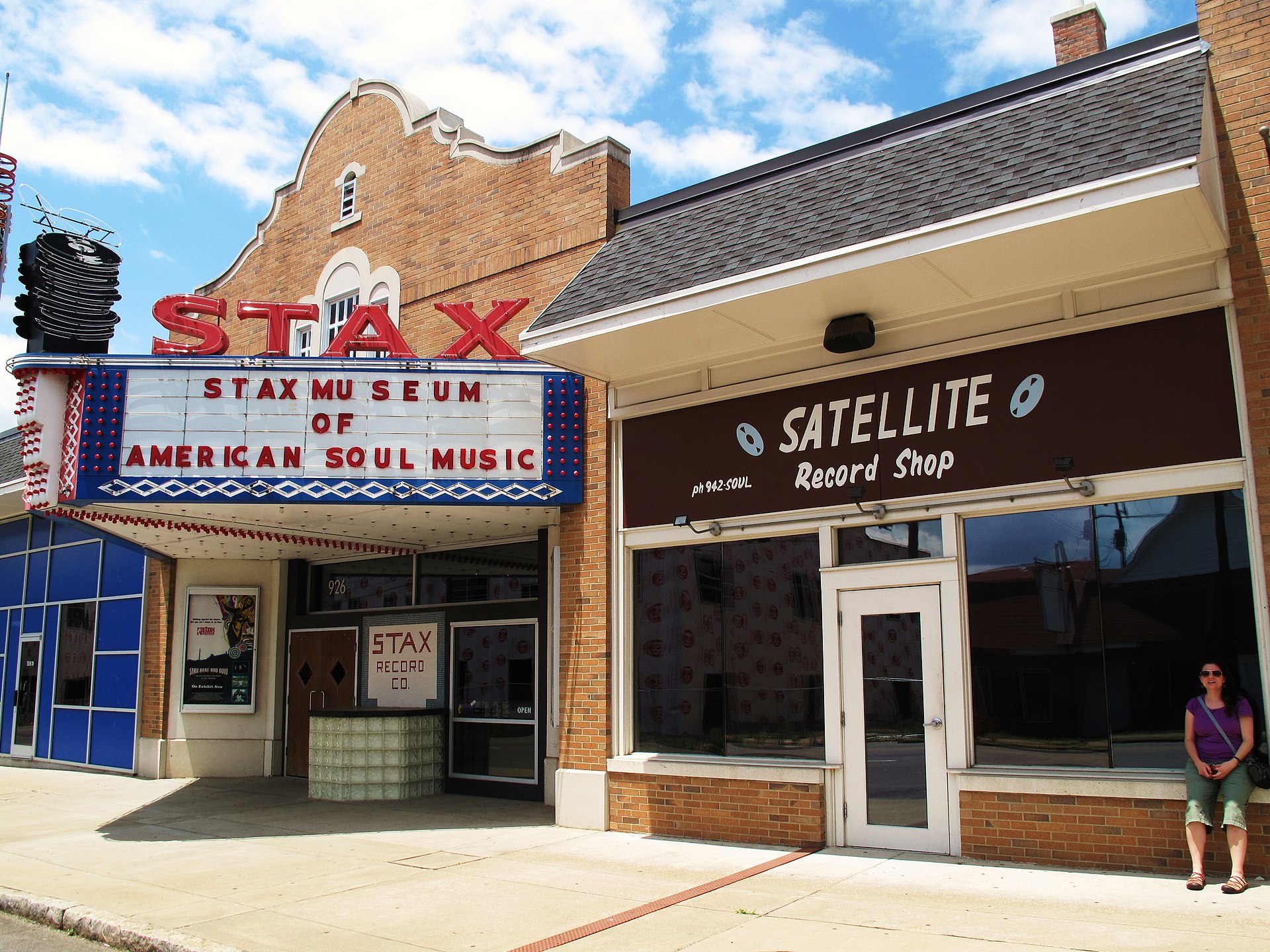
Stax Records began in 1957 as Satellite Records, founded by Jim Stewart and later joined by his sister Estelle Axton; the label was renamed Stax — a blend of Stewart and Axton — in 1961. It operated out of a converted movie theater, the former Capitol Theatre, at 926 E. McLemore Avenue.
Through the 1960s and early 1970s, Stax recorded artists including Otis Redding, Booker T. & the M.G.’s, Sam & Dave, Isaac Hayes, Rufus Thomas, Carla Thomas and The Staple Singers, developing a house sound built on its in-house rhythm section and horn players rather than outside session musicians. The label used “Soulsville U.S.A.” as a self-description, a deliberate counterpart to Detroit’s Motown, which billed itself as “Hitsville U.S.A.” Stax filed for bankruptcy in 1975 and closed the following year; the original building was demolished in 1989.
What is the Soulsville Foundation?
The Soulsville Foundation is the nonprofit organization formed in the late 1990s to rebuild on the site of the original Stax studio and to run the institutions that occupy it. According to the foundation’s own site, it operates three separate but connected entities on and around the McLemore Avenue property: the Stax Museum of American Soul Music, the Stax Music Academy, and the Soulsville Charter School. The foundation describes its mission as using the Stax legacy to support music education and college preparation for young people in the surrounding neighborhood, rather than functioning solely as a heritage attraction.
What can be seen at the Stax Museum today?
The Stax Museum of American Soul Music opened in 2003 on the footprint of the demolished original studio, reconstructed to match the building’s exterior, including its angled marquee. It is the fullest public account of the label’s history in the city.
The museum’s own site describes its holdings as including recording equipment, stage costumes, gold and platinum record awards, and Isaac Hayes’s customized 1972 Cadillac Eldorado, trimmed in gold and fitted with white fur carpeting, on permanent display. The building also houses a reconstructed portion of Studio A, the room where much of the label’s catalog was recorded. Readers building a museum itinerary can compare it with other music-history sites through the Memphis Music Hall of Fame, a separate Downtown institution covering the wider city sound rather than one label.

What is the Stax Music Academy?
The Stax Music Academy is an after-school and summer music education program for Memphis-area students, founded in 2000 as part of the Soulsville Foundation. According to the foundation, the academy teaches instrumental performance, vocal training and the history of the Memphis and Stax sound, drawing directly on the label’s legacy as its curriculum rather than treating that history as a static exhibit. Academy ensembles have performed publicly under the Stax name, a continuation the foundation presents as central to its purpose rather than incidental to it.
What is the Soulsville Charter School?
The Soulsville Charter School is a public charter school serving students from middle school through high school, founded by the Soulsville Foundation in 2005 and located on the same McLemore Avenue campus as the museum and music academy. The foundation states that the school was created to address educational outcomes in the surrounding South Memphis neighborhood, with a college-preparatory model. It is a functioning school with its own enrollment and academic calendar, not a demonstration project attached to the museum, and is not open to casual visitors in the way the museum is.
How does Soulsville connect to the wider history of Memphis music?
Stax is one part of a music history that runs across several Memphis neighborhoods rather than sitting in one place. Sun Studio, where Sam Phillips recorded Elvis Presley, Johnny Cash and others in the 1950s, sits in Midtown, several miles north. Beale Street’s blues clubs are Downtown. Soulsville is distinct from both — it is the South Memphis label that produced a specifically soul and R&B catalog through the 1960s and early 1970s, tied to its own studio, its own musicians, and its own neighborhood rather than a commercial strip. The Museums & Galleries section covers how these separate institutions — Stax, Sun, the Rock ‘n’ Soul Museum, the Hall of Fame — fit together without overlapping.
Is Soulsville a place to visit, or a place people live?
Both, and the distinction matters. Soulsville is a working South Memphis neighborhood with its own residents, church congregations and a functioning K-12 school, not a preserved district maintained for visitors. The Stax Museum, the music academy and the charter school occupy one campus on McLemore Avenue, but the surrounding blocks are ordinary residential South Memphis streets. Anyone researching the wider pattern of how Memphis’s individual districts function — which are largely commercial, which are largely residential, which mix both — can start with the Neighbourhoods archive, which covers Soulsville alongside Orange Mound, Binghampton, Cooper-Young and other named districts.
How do visitors get to Soulsville?
Soulsville is a car-and-transit-accessible neighborhood rather than a walkable extension of Downtown; it does not adjoin the trolley lines or the riverfront paths that connect Downtown, South Main and Midtown. Getting there from Downtown or Midtown typically means a short drive or a Memphis Area Transit Authority bus route, and the museum’s own site is the right place to confirm current hours, admission and directions before any visit, since these details change and this article does not track them. General guidance on how the city’s bus network and driving routes connect its neighborhoods is covered in the Getting Around archive.
Where does Soulsville fit for someone planning a Memphis trip?
For a visitor building an itinerary around Memphis music history, Soulsville is typically treated as a dedicated stop rather than something folded into a Downtown walk, given its distance from the Beale Street and South Main core. The Memphis Guide hub sets out how museums, landmarks and neighborhoods across the city relate to one another, and the Living in Memphis hub covers the neighborhood patterns — South Memphis included — that matter more to residents than to a single day’s visit. Anyone confirming current museum hours or school-related visiting restrictions should check the Soulsville Foundation’s own site directly rather than relying on third-party listings.
Access Memphis is an independent guide written from published, checkable sources. We have not visited the places described here and we do not publish personal recommendations or invented ‘local favourites’ — where something is singled out as notable, we say who says so. Opening times, fares, closures and prices change at short notice, so treat everything here as a starting point and confirm with the museum, operator or venue directly before building a day around it. We give no advice on visas, insurance, health or safety; use your own government’s official guidance for those.
Related reading
Memphis, Practically, What Is the Edge District in Memphis, Explained