What is the Peabody Hotel?
The Peabody Hotel is a historic hotel in downtown Memphis, at 149 Union Avenue, operating continuously (under different owners) since the 19th century in an earlier building and since 1925 in its current one. It is known locally and nationally as “The South’s Grand Hotel” and for a daily event held in its lobby: the march of a small flock of live ducks.
What is the duck march?
The duck march is a scheduled twice-daily walk by a flock of North American mallard ducks, which live in a rooftop enclosure called the Duck Palace and are led by an elevator ride down to the hotel lobby each morning, then back up each evening. A hotel employee, the Duckmaster, walks them across a red carpet to and from a marble fountain, and the walk down draws a crowd in the lobby every day the hotel is open.
The Peabody’s own account of the tradition traces it to the early 1930s, when the hotel’s then-general manager, Frank Schutt, and a friend returned from a hunting trip and, as a joke, put some live decoy ducks in the lobby fountain. Guests were reportedly delighted, and the hotel kept ducks in the fountain afterward. The formal march, with a uniformed Duckmaster and a set route, developed over the following decades and the hotel’s own materials credit a bellman, Edward Pembroke, a former circus animal trainer, with training the ducks to walk the route in the 1940s. Readers wanting the fuller telling of this history should look to the Peabody Hotel’s own site, since the story is the hotel’s own institutional lore rather than an independently documented historical event.
Where does the Peabody sit in Memphis history?
The Peabody name predates the current building by decades; an earlier Peabody Hotel operated in Memphis from the 1860s. The present structure, opened in 1925, was built as a large, full-service hotel in the commercial heart of downtown Memphis, a few blocks from the Mississippi River and near what is now the Beale Street entertainment district. Its scale and central location made it the city’s principal gathering point for business travelers, touring musicians and political figures through much of the 20th century, a role documented in local histories held by institutions such as the Memphis and Shelby County Room, the Memphis Public Library’s local-history archive.
The hotel building is recognized as a historic structure in downtown Memphis; readers wanting the formal listing details, including construction dates and architectural description, should check the National Register of Historic Places’ own records for the Peabody, since specifics of a National Register listing are the kind of detail that should be confirmed at the source rather than restated secondhand.
Who are the ducks, and where do they actually live?
The ducks are North American mallards, kept by the hotel and rotated periodically; the Peabody states that a new set of ducks is typically brought in on a schedule, with the birds living on the property for a limited period before being retired to a farm, and it names an on-site or associated farm as the ducks’ longer-term home. Details of the current rotation schedule, and where the current flock is sourced, are the kind of operational fact that changes and should be confirmed on the Peabody Hotel’s own site rather than assumed from an old article.
The march itself follows a fixed daily pattern rather than a single one-off event: down from the Duck Palace in the morning, into the fountain for the day, and back up in the late afternoon. The exact times are set by the hotel and can change with the season or with hotel events, so anyone planning to see the march — resident or visitor — should confirm the current schedule directly with the Peabody rather than relying on a remembered time.

What else is inside the hotel?
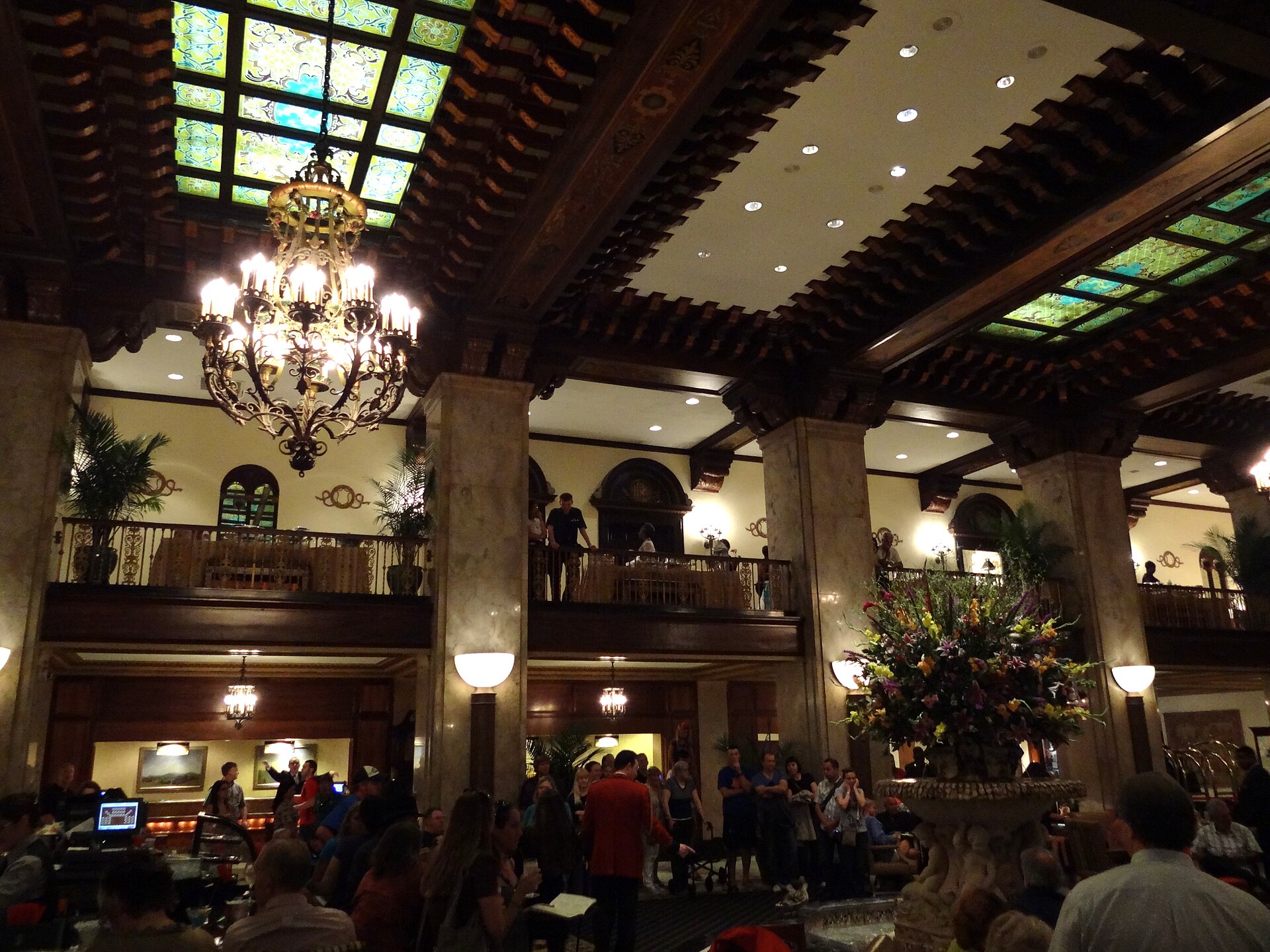
Beyond the fountain and lobby, the Peabody functions as a working hotel with guest rooms, event and ballroom space, and a rooftop area that historically hosted rooftop dining and dancing in the mid-20th century, a use documented in local Memphis histories of the period. It is not a museum and does not hold a public collection in the way the city’s institutions do; there is no ticketed exhibit inside the building. The duck march is free to watch from the lobby, though the hotel’s own site is the place to confirm whether any viewing area requires being a guest or diner at a given time.
Because it sits in the middle of downtown, the Peabody is often discussed alongside other downtown landmarks rather than as a standalone destination. Visitors combining it with a downtown day frequently pair it with Beale Street, the Memphis Rock ‘n’ Soul Museum, or the Cotton Museum at the old Memphis Cotton Exchange, all within easy walking distance of Union Avenue.
Does the duck march affect visiting the hotel?
Yes, in a practical sense: the lobby is at its most crowded around the two daily march times, and hotel staff manage the red-carpet route and the fountain area accordingly during those windows. Outside those times, the lobby functions as an ordinary hotel lobby. Anyone wanting a clear view of the march itself should plan to arrive before the scheduled walk, since the crowd forms along the carpet ahead of the ducks’ appearance, according to the hotel’s own description of the event.
As with any specific timing, ticketing or dining detail tied to a commercial operator, this is exactly the kind of practical fact that this site treats as perishable. Confirm current march times, any dining reservations tied to viewing, and event-related closures directly on the Peabody Hotel’s own site before visiting.
Is the Peabody a stop only for visitors, or does it matter to residents too?
The Peabody functions in Memphis public life beyond the duck march: its ballrooms and meeting spaces are used for the kind of civic dinners, conferences and social events that make up a working downtown hotel’s business, and it appears repeatedly in local historical accounts of downtown Memphis’s development across the 20th century. For a resident, it is as much a landmark of downtown’s built environment as a curiosity — a fixed point on the map used the way any long-standing grand hotel is used in a city center, for meetings, weddings and out-of-town guests rather than as a daily attraction.
For visitors building a downtown itinerary, the Peabody sits naturally alongside other stops covered in the Access Memphis guide to museums, landmarks and neighborhoods, and the practical questions of getting downtown, parking and timing a day around it are covered more generally in the site’s practical planning hub. Readers who live in Memphis and want a wider sense of how downtown functions day to day, beyond any single landmark, can start with the Living in Memphis hub.
Where does the Peabody fit among Memphis’s landmarks and museums?
The Peabody is a hotel, not a museum, so it sits in a different category from the city’s collecting institutions, but it is frequently mentioned in the same downtown context as places covered in the Landmarks & Sights archive and the Museums & Galleries archive. Readers assembling a downtown day that includes free or low-cost stops may also want the overview at which Memphis museums are free, and when to visit, since several of downtown’s museums sit within a short walk of Union Avenue and the Peabody’s front doors.
What makes the Peabody distinct from those institutions is precisely that it has no formal collection or curator — its record is institutional and anecdotal, kept by the hotel itself, and the duck march is best understood as a long-running hospitality tradition rather than a historical event with independent documentation. Readers wanting the fullest and most current account of the tradition’s origin, the Duckmaster’s role, and today’s schedule should treat the Peabody Hotel’s own site as the primary source, and treat any other retelling — including this one — as secondary to it.
Access Memphis is an independent guide written from published, checkable sources. We have not visited the places described here and we do not publish personal recommendations or invented ‘local favourites’ — where something is singled out as notable, we say who says so. Opening times, fares, closures and prices change at short notice, so treat everything here as a starting point and confirm with the museum, operator or venue directly before building a day around it. We give no advice on visas, insurance, health or safety; use your own government’s official guidance for those.
Featured image: Photo by Adam Jones from Kelowna, BC, Canada, source, CC BY-SA 2.0
.jpg)