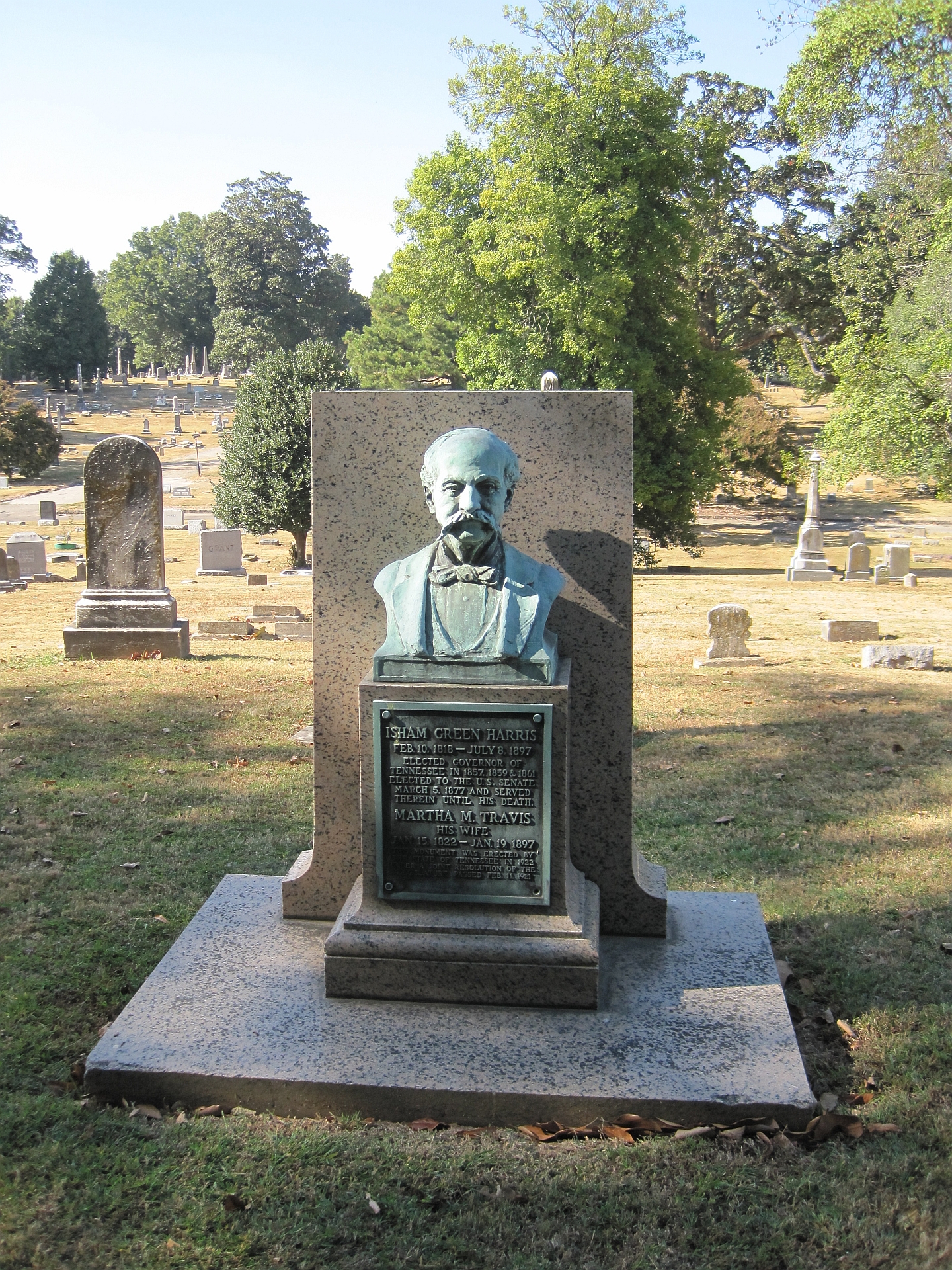
Elmwood Cemetery is a roughly 80-acre burial ground in South Memphis, founded in 1852 and still active today. It holds the remains of Memphis mayors, cotton merchants, yellow fever victims from the 1878 epidemic, and Confederate general Nathan Bedford Forrest, whose grave was moved there in 2021 after decades in a public park.
What kind of place is Elmwood Cemetery?
Elmwood is what 19th-century Americans called a “rural cemetery” — a landscaped burial ground designed as much for walking and reflection as for interment, laid out with curving drives, mature trees and a formal planting plan rather than a flat grid of stones. It was chartered in 1852 by a group of Memphis citizens as a private, nonprofit cemetery company, and it has operated continuously since, making it the oldest cemetery in the city still accepting burials.
That continuity matters. Because Elmwood was never abandoned, deconsecrated or absorbed into a public parks system, its Victorian-era monuments, ironwork and family plots survive largely intact, which is part of why the cemetery is treated as a historical archive of Memphis as much as a place of burial.
Where is it, and what does it look like?
Elmwood sits at 824 South Dudley Street, in South Memphis, southeast of Downtown and not far from the neighborhoods covered in Access Memphis’s neighbourhoods coverage. The grounds function as a de facto arboretum, with old-growth trees, ponds and winding roads that predate the automobile-era grid around them. Unlike a municipal park, the site is privately maintained by the Elmwood Cemetery nonprofit, which is also responsible for its historical records and tour programming.
Is Elmwood on the National Register of Historic Places?
Yes. Elmwood Cemetery is listed on the National Register of Historic Places, a federal designation that recognizes its significance as a landscaped burial ground and as a record of Memphis civic, business and military history from before the Civil War through the 20th century. The listing covers the grounds and their monuments as a historic district rather than any single grave.
Who is buried at Elmwood Cemetery?
Elmwood’s own historical materials describe a burial population that reads like a cross-section of Memphis history rather than a single theme. Its records and published tour guides point to several categories of graves that recur across the site:
- Memphis mayors and civic officials, including E.H. “Boss” Crump, the political figure who dominated city government for decades in the early 20th century.
- Cotton factors, riverboat captains and merchants from Memphis’s 19th-century commercial economy, many buried along the elaborately monumented section informally known as “Millionaire’s Row.”
- Confederate and Union soldiers, reflecting Memphis’s position on the Mississippi River during the Civil War.
- Victims of the 1878 yellow fever epidemic, buried in significant numbers in a dedicated section of the grounds.
- Annie Cook, a Memphis madam who, according to Elmwood’s own published history, stayed in the city during the 1878 epidemic to nurse the sick and died of the disease herself.
For readers researching a specific name, the cemetery’s own site and the Memphis and Shelby County Room at the Memphis Public Library both maintain burial and genealogical records that go beyond what any single article can list.
What happened with Nathan Bedford Forrest’s grave?
Forrest, the Confederate cavalry general and early Ku Klux Klan leader, was originally buried at Elmwood after his death in 1877. In 1904, his remains and those of his wife were moved to a Memphis park that was later named Forrest Park in his honor, where an equestrian statue was erected over the site. Following the city’s long-running dispute over Confederate monuments on public land — and the removal of the statue itself in 2017 — Forrest’s remains were exhumed and reinterred at Elmwood in 2021, returning them to the cemetery where they had first been buried.
This is a documented, reported sequence of events rather than a matter of local legend, and it is worth understanding alongside the city’s other Confederate-era and civil-rights sites, several of which Access Memphis covers directly, including Clayborn Temple and the National Civil Rights Museum at the Lorraine Motel.
What does Elmwood hold from the 1878 yellow fever epidemic?
The 1878 yellow fever epidemic was one of the deadliest events in Memphis history, killing thousands of residents in a matter of months and driving much of the city’s population to flee. Elmwood’s own historical account describes a section of the cemetery given over to epidemic burials, including graves of the doctors, nurses and clergy who stayed in the city to treat the sick, several of whom died of the disease themselves. This section is presented by the cemetery as a distinct historical record of the epidemic rather than as ordinary family plots, and it is one of the reasons Elmwood is treated as a primary source for 19th-century Memphis public health history, not just a burial ground.
Can visitors go, and how does that work?
Elmwood functions as a working cemetery first, which means access follows the cemetery’s own posted hours and rules rather than a museum’s opening times — readers should confirm current visiting hours, any entry conditions and tour offerings directly on Elmwood’s own site before planning a visit. The nonprofit that runs the cemetery publishes self-guided walking and driving tour materials and periodically runs staffed historical tours, according to its own published programming; specifics of what is currently on offer should be checked there rather than assumed from older listings.
Because the grounds are a working burial site with active family plots, visitors should expect the same conduct expected in any cemetery — quiet, respectful movement rather than casual sightseeing behavior, and no assumption that every area is open to the public in the same way as a park.
How does Elmwood fit into Memphis life today?
For residents, Elmwood functions less as a single tourist stop and more as a piece of civic infrastructure — a large green space, an arboretum, and a genealogical archive that families and historians consult directly. It sits outside the cluster of museums most first-time visitors plan around, which the Access Memphis Memphis guide and museums and galleries coverage lay out in more detail, and it is not typically bundled with sites like the National Civil Rights Museum or Beale Street on a single day’s itinerary.
It is, however, a useful counterweight to the city’s more polished historic districts, such as the grand residential blocks described in Access Memphis’s piece on Victorian Village: where that neighborhood shows how wealthy 19th-century Memphis families lived, Elmwood shows, in a fairly literal sense, how the same city’s population — mayors, cotton merchants, epidemic victims and Confederate dead alike — was eventually buried. Readers building a broader picture of how the city developed and who shaped it may find it useful alongside Access Memphis’s Living in Memphis hub and the Landmarks & Sights archive, both of which cover how Memphis’s history is documented and preserved in the built environment rather than performed for visitors. For planning practicalities around getting to South Memphis and combining a visit with other sights, the Memphis practical hub and Getting Around archive cover the city’s transport options in more detail.
Access Memphis is an independent guide written from published, checkable sources. We have not visited the places described here and we do not publish personal recommendations or invented ‘local favourites’ — where something is singled out as notable, we say who says so. Opening times, fares, closures and prices change at short notice, so treat everything here as a starting point and confirm with the museum, operator or venue directly before building a day around it. We give no advice on visas, insurance, health or safety; use your own government’s official guidance for those.
Featured image: Photo by Thomas R. Machnitzki, source, BY