What is the Shelby County Courthouse?
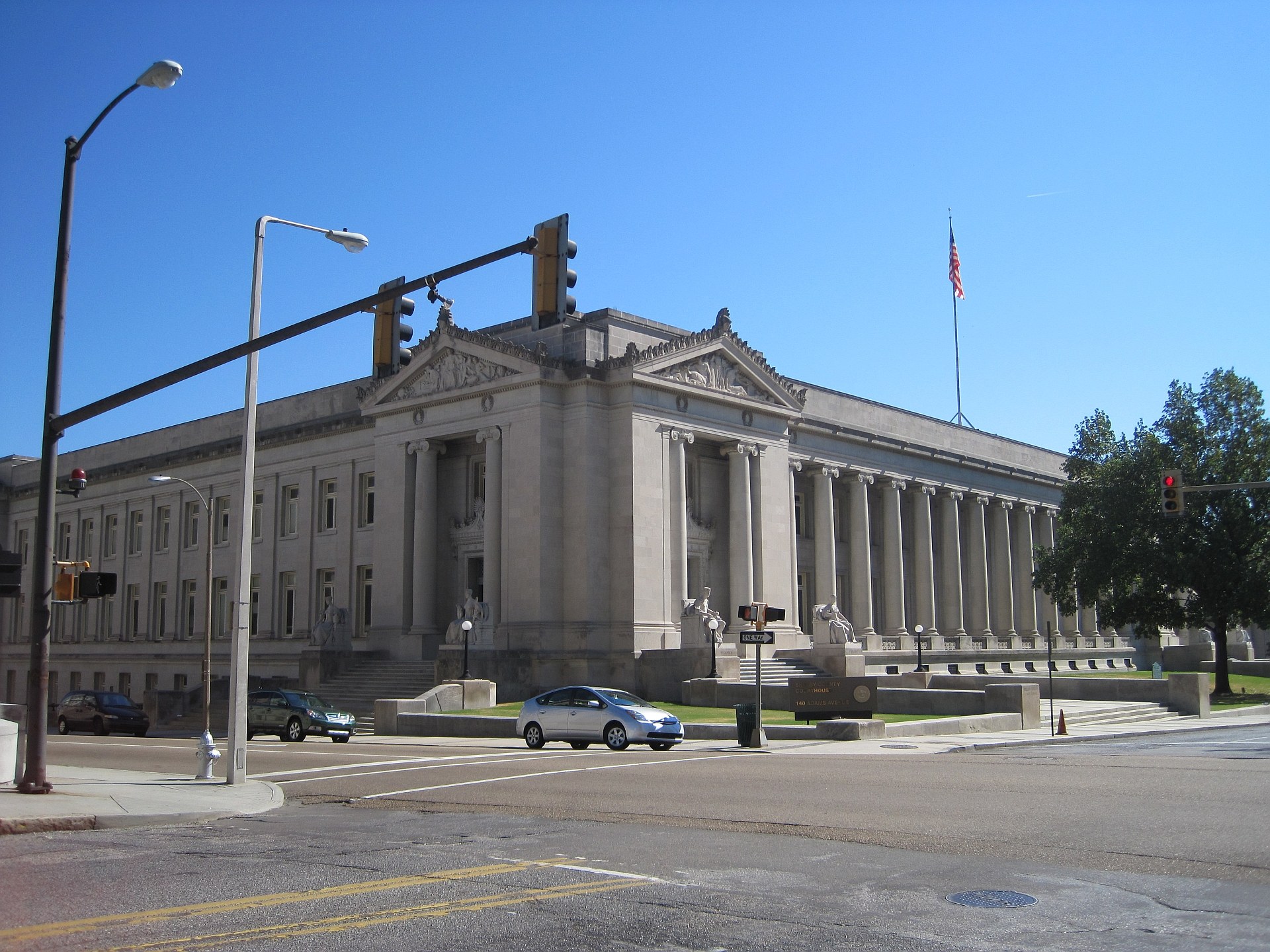
The Shelby County Courthouse is the county’s historic seat of civil justice, standing at 140 Adams Avenue in Downtown Memphis. Completed in 1910 in the Neoclassical style common to American courthouses of that era, it remains an active, working courthouse today and sits at the center of the city’s Civic Center area, a short walk from the Mississippi River bluff.
Where is it, and what surrounds it?
The courthouse sits on Adams Avenue between Second and Third Streets, in the cluster of civic buildings Memphis planners refer to as the Civic Center. Memphis City Hall stands nearby, along with other early-twentieth-century public buildings that together form part of what the city and preservation records describe as a civic historic district downtown. The area lies within easy walking distance of the river bluff and the older commercial core covered in the site’s Neighbourhoods archive.
The setting is deliberately institutional rather than commercial: county and city offices, court buildings, and a public library sit within a few blocks of each other, a layout typical of American county seats built in the same period.
When was it built, and in what style?
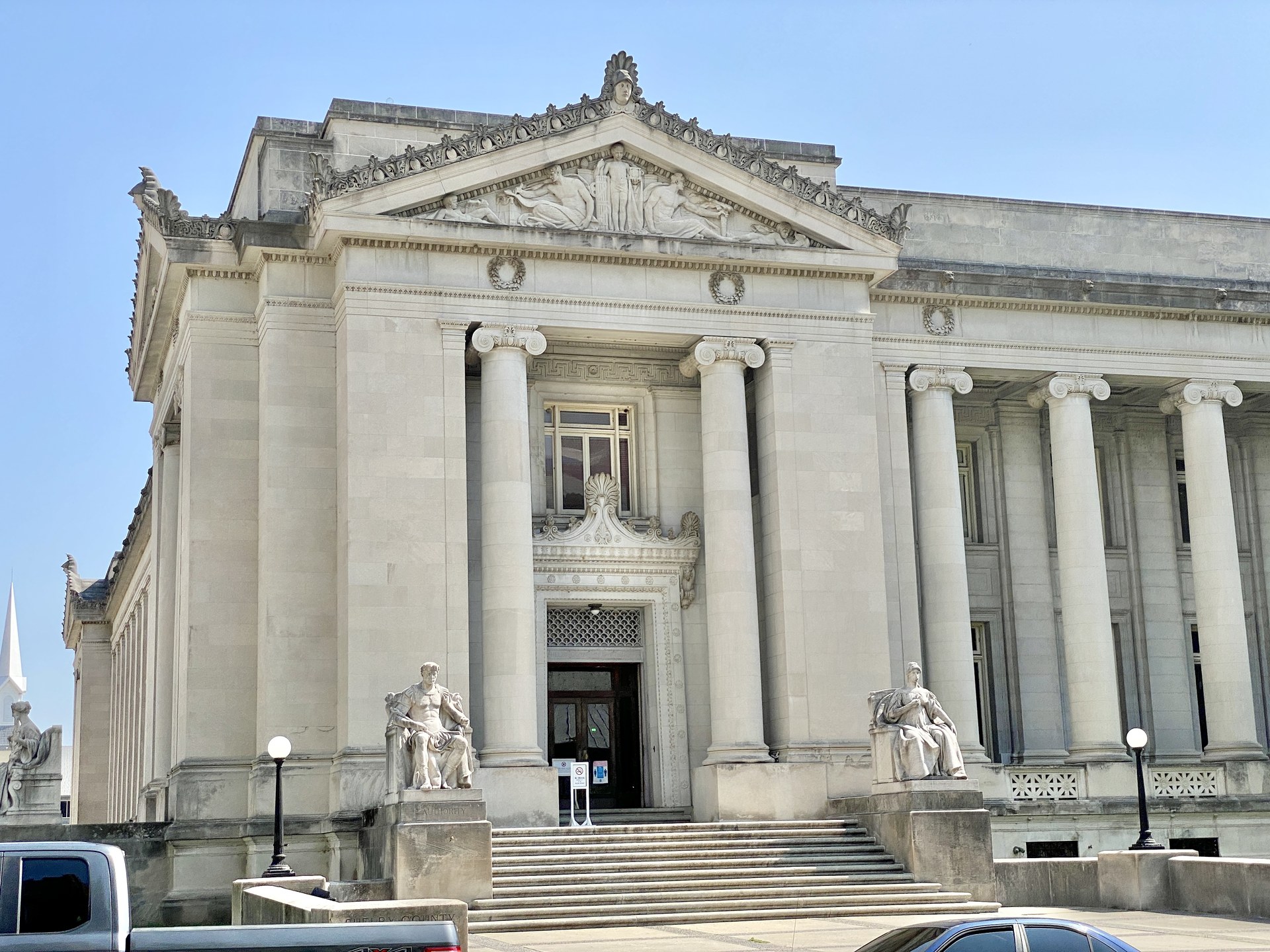
Construction on the current courthouse began in the first decade of the twentieth century and finished around 1910, replacing an earlier, smaller county courthouse on the same downtown site. The building follows the Neoclassical, or Beaux-Arts-influenced, design vocabulary that dominated American courthouse architecture in that period: a raised base, a colonnaded portico facing the street, and a symmetrical stone facade meant to project permanence and civic authority rather than commercial display. That vocabulary is the same architectural language used for many of the era’s federal customs houses, state capitols, and county courthouses across the South.
The building’s scale and materials — dressed stone, a deep entrance portico, a raised podium approached by a broad flight of steps — were standard choices for a courthouse meant to serve as the county’s principal seat of civil authority for generations, not a temporary or modest facility.

What functions does the courthouse serve today?
Shelby County’s court system, like many large urban county systems, now operates across more than one building. Criminal matters are handled through the county’s dedicated criminal justice complex elsewhere downtown, while the 1910 courthouse on Adams Avenue continues to house civil court functions — among them circuit, chancery, and probate matters administered by Shelby County. Readers with an actual case, filing, or jury summons should confirm the correct building and current procedures directly through Shelby County’s own government site, since court assignments and building use can change administratively.
This split between an older civil courthouse and a newer criminal complex is common in growing American counties, where the original courthouse was never designed for the caseload of a modern metropolitan area and additional facilities were added over the twentieth century rather than replacing the historic building outright.
Is the courthouse open to the public?
As an active government building, the courthouse operates on a public-access basis similar to any working courthouse: visitors with legitimate business — filing documents, attending a hearing, conducting research in county records — can generally enter during posted business hours, subject to security screening. It is not a museum and has no visitor program, ticketed tours, or interpretive exhibits of the kind covered in the site’s Museums & Galleries archive. Hours, security procedures, and which entrances are in use can change, so anyone planning a visit for county business should check Shelby County’s own site for current information rather than relying on a general description.
How does it fit into Memphis’s Civic Center?
The courthouse is one anchor of a small cluster of early-twentieth-century civic buildings that Memphis and county government still use for their original purposes, an unusual degree of continuity for a downtown core that has otherwise seen substantial redevelopment. Where much of Downtown Memphis has been reshaped around entertainment, sports, and riverfront investment — patterns covered in the site’s Memphis Practical hub — the Civic Center has remained functionally what it was built to be: the seat of city and county administration and law.
That continuity is part of what distinguishes the courthouse from the landmarks most visitors associate with Downtown Memphis. It was never built for tourism and has no equivalent narrative arc to a museum or music site; its significance is administrative and architectural rather than commemorative.
What else is nearby worth knowing about?
The Civic Center sits within a few blocks of several landmarks covered elsewhere on this site, useful context for anyone building an itinerary that treats Downtown Memphis as a whole rather than a single attraction:
- Central Station, the restored rail depot a short distance south, explained in what runs from Central Station.
- The Orpheum Theatre, the restored 1920s movie-palace-turned-performing-arts venue on South Main, detailed in what the Orpheum Theatre is.
- The Memphis Pyramid on the riverfront, now a retail and outdoor destination, explained in why Bass Pro Shops occupies the Pyramid.
For a broader sense of how Downtown’s landmarks, museums, and neighbourhoods connect, the site’s Memphis Guide hub and its Landmarks & Sights archive lay out the wider pattern the courthouse fits into: a downtown built in overlapping waves — cotton-trade commerce, early civic administration, and later entertainment and riverfront investment — each still visible in a different cluster of surviving buildings.
Why does this building matter to how Memphis actually works?
For residents, the Shelby County Courthouse is less a sight than an address: the place where property records, civil filings, and probate matters are handled, distinct from the criminal courts and jail complex known locally by their own street addresses. For visitors, its relevance is architectural and contextual — a marker of what Downtown Memphis looked like before the city’s economy reorganized itself around music, tourism, and the riverfront, and a reminder that a functioning county government still occupies part of that original civic footprint.
Both readings are accurate at once. The building has not been repurposed into a museum or event space, and there is no indication that it will be; its durability as a landmark comes precisely from the fact that it still does the job it was built for in 1910.
Access Memphis is an independent guide written from published, checkable sources. We have not visited the places described here and we do not publish personal recommendations or invented ‘local favourites’ — where something is singled out as notable, we say who says so. Opening times, fares, closures and prices change at short notice, so treat everything here as a starting point and confirm with the museum, operator or venue directly before building a day around it. We give no advice on visas, insurance, health or safety; use your own government’s official guidance for those.
Featured image: Photo by Billy Hathorn, source, CC BY-SA 3.0
