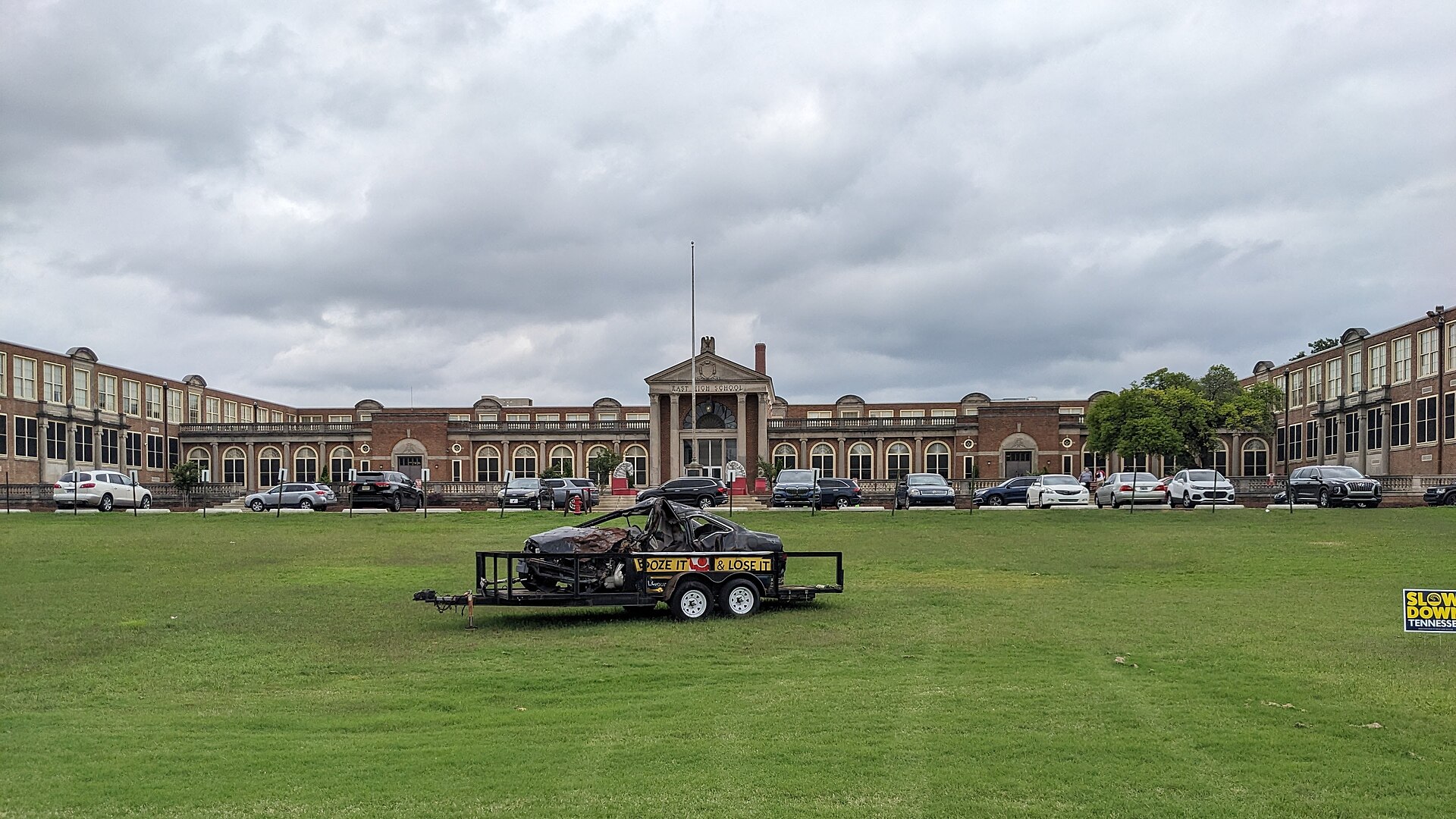
East Memphis is the large, largely residential and commercial district that lies east of Midtown, roughly between the I-240 loop and the city’s eastern limits. It has no fixed municipal boundary, but it is understood locally as the area centered on Poplar Avenue, home to office towers, single-family neighborhoods, and several of the city’s museums and gardens.
Where are East Memphis’s boundaries?
East Memphis has no legal border — it is a real estate and civic term, not a city ward. Most residents and planners place its western edge at or near I-240, where Midtown ends, with the district extending east along Poplar Avenue and Walnut Grove Road toward the city line shared with Germantown. North–south, it is generally described as running from around Sam Cooper Boulevard down to Poplar and Perkins, though definitions stretch further south toward Mt. Moriah depending on who is drawing the line.
Because the boundary is informal, East Memphis is often used loosely to cover everything between Midtown and the suburbs, including named pockets such as Chickasaw Gardens, Colonial Acres, and the area around White Station. For a comparison of where the more tightly defined district to its west begins and ends, see the explainer on Midtown Memphis, and for Downtown’s own boundary lines, the piece on Downtown Memphis’s boundaries.
How did East Memphis develop?
East Memphis grew as Memphis expanded eastward in the mid-20th century, following the pattern of most American cities in the postwar decades: new subdivisions, then retail, then offices, built along an existing corridor — in this case, Poplar Avenue, one of the city’s oldest east–west roads. As downtown Memphis lost commercial ground through the 1960s and 1970s, companies and professional offices relocated along Poplar, and the corridor took on a second commercial identity for the city, one built around car access and low-rise office parks rather than a traditional downtown core.
The city’s Memphis 3.0 comprehensive plan, adopted in 2019, treats the Poplar Avenue corridor as one of Memphis’s significant commercial corridors outside downtown, reflecting the density of office, medical, and retail activity that has accumulated there over decades. That planning designation is one of the few semi-official acknowledgments that East Memphis functions as a distinct economic zone within the city, even without a formal boundary.
What museums and gardens are in East Memphis?
East Memphis holds two of the city’s notable cultural institutions, both set on landscaped grounds rather than in a dense museum district. The Memphis Botanic Garden occupies part of Audubon Park and maintains a series of themed gardens open to the public; its own site lists the collection areas and current hours. Adjacent to it is the Dixon Gallery and Gardens, an art museum built around a private collection of French and American Impressionist and related works, set in formal gardens that are themselves part of what the institution shows visitors.
These two sit apart from the museum concentration found downtown and in Midtown. For the fuller citywide list — including which collections offer free admission on specific days — see the Museums & Galleries archive and the guide to which Memphis museums are free, and when.

What is East Memphis known for besides its offices?
Beyond its office corridor, East Memphis is known for its scale of single-family housing, its shopping centers along Poplar Avenue, and its concentration of Memphis City Schools’ magnet and optional programs, which draw families from across the district. It is also where several of Memphis’s larger private and public high schools are located, a factor that shapes the district’s demographics as much as its commercial base does.
Unlike Midtown or South Main, East Memphis was not built around a single historic commercial strip or arts district; it developed as a set of adjoining subdivisions and shopping nodes stitched together by Poplar Avenue, Walnut Grove Road, and Ridgeway Road. That difference in origin is part of what separates it, in form and function, from the neighborhoods covered in the Neighbourhoods archive, most of which grew around a streetcar line, a rail depot, or a specific industry.
What is East Memphis like to live in?
For residents, East Memphis functions as a car-dependent suburb within city limits — wide arterial roads, shopping centers with parking lots rather than street-front retail, and residential streets set back from the main corridors. It contrasts with Midtown’s walkable grid and Downtown’s converted commercial buildings, and it is generally the part of Memphis that reads most like conventional postwar suburbia, despite sitting entirely inside the city’s borders.
Housing stock ranges from smaller postwar ranch homes near the older sections to larger newer construction toward the eastern edge, closer to Germantown and Collierville. The area’s office concentration also means weekday traffic on Poplar Avenue and the I-240/Poplar interchange is heavier than in more residential parts of the city, a pattern any resident moving there should factor into a daily commute. For a broader look at what living anywhere in the city actually involves — costs, schools, and how neighborhoods differ block to block — see the Living in Memphis hub.
How do you get around East Memphis?
East Memphis is built for driving. Poplar Avenue, Walnut Grove Road, Sam Cooper Boulevard, and Park Avenue carry most east–west traffic, while Perkins, White Station, Mendenhall, and Ridgeway carry north–south traffic. MATA, the Memphis Area Transit Authority, runs bus routes along several of these corridors, including Poplar, but service frequency and route detail should be confirmed on MATA’s own site rather than assumed, since transit patterns in car-oriented districts change more often than in the denser core.
There is no rail or streetcar service in East Memphis; the trolley system operates downtown, and Amtrak’s regional service runs from Central Station, well to the west. For a citywide view of how the transit network fits together, including where East Memphis sits relative to it, see the Getting Around archive and the Memphis Practical hub.
How does East Memphis compare to Midtown and Downtown?
Downtown Memphis is the historic commercial core along the river, built around 19th- and early 20th-century buildings and now anchored by tourism and civic institutions. Midtown is the older streetcar-era ring immediately east of downtown, denser and more walkable, with named districts such as Cooper-Young and Overton Square. East Memphis is a further ring out again — later, lower-density, and organized around the automobile and the office park rather than the block and the storefront.
Understanding East Memphis, then, is partly about understanding what it is not: it is not a historic district with a preservation designation, and it does not appear on the National Register of Historic Places as a unit the way Cooper-Young or Victorian Village do. It is a working commercial and residential zone, defined by function and convention rather than by any listed boundary — which is precisely why residents and visitors alike tend to define it slightly differently depending on where they are standing.
For a wider frame on how all of Memphis’s districts fit together — which ones have official historic status, which are informal, and how they connect to each other — the Memphis Guide hub is the place to start.
Access Memphis is an independent guide written from published, checkable sources. We have not visited the places described here and we do not publish personal recommendations or invented ‘local favourites’ — where something is singled out as notable, we say who says so. Opening times, fares, closures and prices change at short notice, so treat everything here as a starting point and confirm with the museum, operator or venue directly before building a day around it. We give no advice on visas, insurance, health or safety; use your own government’s official guidance for those.
Featured image: Photo by ElToAn123, source, CC BY-SA 4.0
