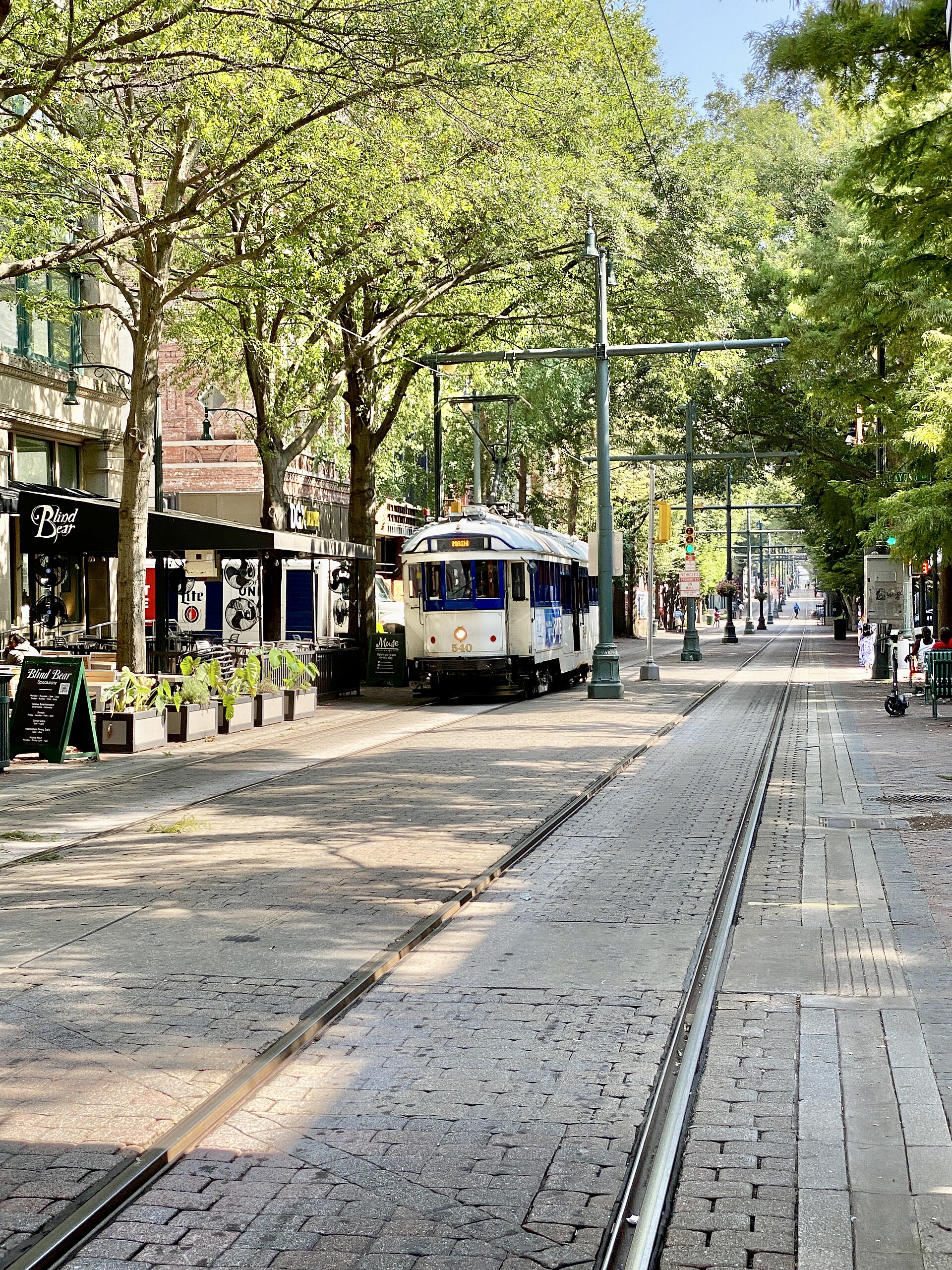
Memphis is walkable in sections, not as a connected whole. A handful of districts — Downtown, South Main, parts of Midtown — are dense enough to cover on foot for a day or two. Between those districts, and across most of the rest of the city, distances and road design make a car or transit the practical choice.
Which parts of Memphis are actually walkable?
The walkable core sits along and near the Mississippi River bluff: Downtown Memphis, the South Main Arts District immediately south of it, and the Edge District to the north. Inland, Midtown neighborhoods including Cooper-Young, Overton Square and the area around Crosstown Concourse are walkable within themselves, though they are two to three miles apart from each other and from Downtown.
Outside these zones — East Memphis, Whitehaven, Frayser, Germantown, Collierville — the street grid was built for cars, with wide arterial roads, shopping centers set back from the sidewalk, and long blocks. A destination like Graceland sits on Elvis Presley Boulevard in Whitehaven, a corridor designed around vehicle traffic rather than pedestrians.
Is Downtown Memphis walkable?
Yes, within its own boundaries. Downtown Memphis is compact enough that a visitor can move between its main landmarks on foot in well under an hour, though the district is larger and less uniform than its tourist core suggests.
The area’s own boundaries run roughly from the river bluff east to the freight rail corridor near Danny Thomas Boulevard, and from the Pyramid area in the north down to the Edge and South Main districts — a full account of the shape is in what defines Downtown Memphis and where its boundaries sit. Within that, Beale Street, the Orpheum Theatre, the Shelby County Courthouse, and the National Civil Rights Museum at the former Lorraine Motel are all within a short walk of each other, and of Central Station, the city’s rail terminal and a stop on multiple transit lines.
Sidewalks are consistent through this stretch, and the district’s flat, gridded layout — a legacy of its riverfront platting — makes orientation straightforward even without a map.
What about South Main and the Arts District?
South Main is walkable and connects directly to Downtown’s southern edge, forming a single continuous pedestrian stretch of roughly a mile and a half.
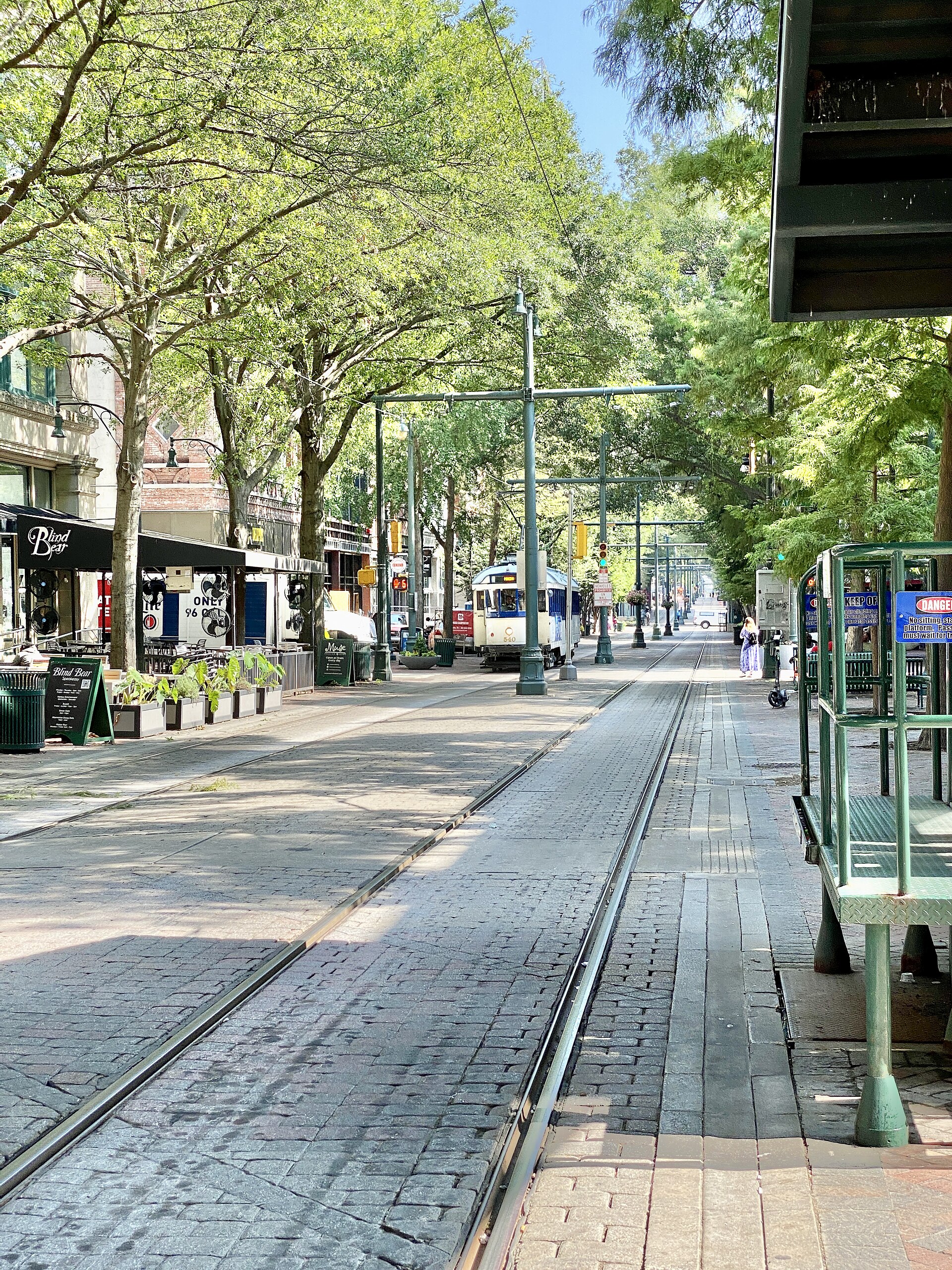
The South Main Arts District runs south from the Downtown core toward the National Civil Rights Museum, and its historic warehouse and rail-depot buildings sit close together on a narrow grid. The Main Street Trolley runs the length of this corridor, which matters for anyone who wants to walk one direction and ride back — a full explanation of the route and stops is at what the Main Street Trolley is and where it runs.
Is Midtown walkable?
Midtown is walkable neighborhood by neighborhood, not as a single continuous district — Cooper-Young, Overton Square and the Broad Avenue Arts District are each compact on their own but sit roughly a mile or more apart.
Cooper-Young is a historic residential and commercial district centered on the intersection of Cooper Street and Young Avenue, with a walkable grid of storefronts and bungalows. Overton Square, a theater and entertainment district near Overton Park, sits about a mile northwest of Cooper-Young. Broad Avenue is farther north still, a strip of restored storefronts developed as an arts corridor.
A full account of how these pieces relate to each other, and why residents often describe Midtown as the city’s actual center of gravity rather than Downtown, is at what Midtown Memphis is, and why it functions as the real city.
.jpg)
What is not walkable in Memphis?
Most of the city, by area, is not designed for walking between destinations. East Memphis, Whitehaven, Frayser, Binghampton and the suburban municipalities of Germantown and Collierville are built around arterial roads, strip development and single-use zoning that separates housing from commerce.
East Memphis is a large, affluent district of offices, shopping centers and residential subdivisions with no single walkable core comparable to Midtown’s. Germantown and Collierville are separate incorporated municipalities within Shelby County, built at a lower density and with a road network that assumes a car for nearly every trip.
This is not a judgment on those places — it is simply how they were built, decades after Downtown and Midtown, under a different set of planning assumptions.
Do you need a car if you’re staying somewhere walkable?
Not necessarily inside one district, but almost certainly to move between districts, or to reach landmarks like Graceland, Stax, or the airport. Whether a car is worth renting depends on the itinerary, and the honest tradeoffs are worked through at do you need a car in Memphis — an honest answer.
For getting between Downtown and Midtown without driving, MATA — the Memphis Area Transit Authority — runs fixed bus routes covering most of the city; how the network is structured is explained at what MATA is, and how good the Memphis bus network actually is. For current routes, fares and schedules, MATA’s own site at matatransit.com is the source to check, since timetables and fare structures change.
The distance between the city’s best-known music landmarks — Beale Street, Sun Studio, Stax and Graceland — is greater than it appears on a souvenir map; the actual mileage between each is laid out at how far apart Beale Street, Sun Studio, Stax and Graceland really are, and it confirms that no single walk connects them.
How does parking fit into a walkable itinerary?
Anyone driving into a walkable district still has to park somewhere first, and Downtown Memphis has its own system of metered street parking, garages and specific rules that differ from a typical American downtown. Those mechanics are covered at how parking works in Downtown Memphis.
What does walkability mean for someone who actually lives here?
For a resident, walkability tends to track directly with which neighborhood someone chooses, and it shapes daily patterns more than any citywide policy does. Someone living in Cooper-Young or South Main can plausibly run errands on foot; someone in East Memphis or a Shelby County suburb is planning around a car by default.
This split is one of the more consistent facts about how the city actually functions day to day, and it is covered at greater length in the guide to what living in Memphis is actually like, alongside the broader practicalities of getting around covered at planning a visit or a life around Memphis’s transport and geography.
The neighborhoods that make up this patchwork — their boundaries, their histories, and what actually defines each one — are catalogued individually in the site’s Neighbourhoods archive.
Access Memphis is an independent guide written from published, checkable sources. We have not visited the places described here and we do not publish personal recommendations or invented ‘local favourites’ — where something is singled out as notable, we say who says so. Opening times, fares, closures and prices change at short notice, so treat everything here as a starting point and confirm with the museum, operator or venue directly before building a day around it. We give no advice on visas, insurance, health or safety; use your own government’s official guidance for those.
Featured image: Photo by Warren LeMay from Chicago, IL, United States, source, CC BY-SA 2.0
.jpg)